
An intermediate level English resource on London
London: THE LORD MAYOR'S SHOW
It is the oldest annual parade in the world, and it takes place in London. But since it takes place in the middle of November, when there are not too many tourists in the capital, the "Lord Mayor's Show" is an event that is not very well known outside the city.
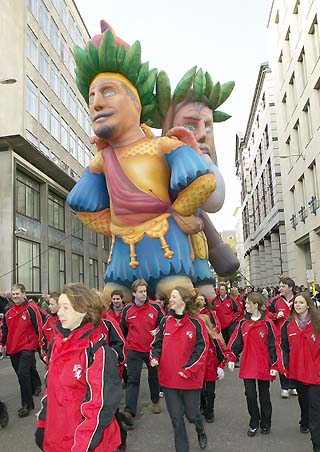 The first Lord
Mayor's Show took place in the year 1215, after King John gave
Londoners the right to choose
their own representative. Like today's event, it was a fairly exciting
procession, during which London's new "Lord Mayor" was "shown" to the
people of the city.
The first Lord
Mayor's Show took place in the year 1215, after King John gave
Londoners the right to choose
their own representative. Like today's event, it was a fairly exciting
procession, during which London's new "Lord Mayor" was "shown" to the
people of the city.
Originally, the new Lord Mayor had to present himself to the Law Courts for approval by the King, and to swear loyalty. Today, the Show is always attended by representatives of the Crown.
For many years, until 1856 the procession included making part of the journey by barge along the Thames. Now the Show winds its way through the streets of the City.
It is usually the biggest free show of the year for Londoners; and for many years, it has been an exotic or spectacular occasion. In the year 1602, for example, the ordinary people of London were able to see a lion and a camel in the procession. Most people had never seen these strange animals before!
The Lord Mayor
In the olden days, when "London" was all contained within the walls of the "City", the Lord Mayor was a powerful figure. He was the representative of the people of London, a man who was chosen by the most important people in the city; he was not appointed by the King.
Today, the "City" has a population of about 6,000 people - less than 0.1% of the population of the modern city of "Greater London". And as far as this modern London is concerned, the Lord Mayor of the City is not a very important person. For instance, he is far less important than the directly elected "Mayor of London", who is really in charge of the capital's affairs.
On the other hand, the Lord Mayor is a representative of the "City", the most important financial centre in Europe; and although many of his functions are ceremonial, he also plays an important role in the world of international business.
Naturally, the Lord Mayor's Show is has little to do with business. London's corporations may pay for it, but it is a show for the people.
THE MODERN SHOW
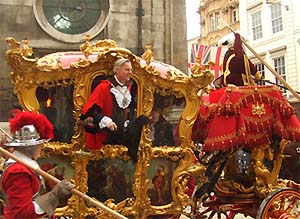 In today's Lord Mayor's Show,
the new mayor rides in his ceremonial carriage
at the head of a long procession of vehicles, floats
and marching bands.
In today's Lord Mayor's Show,
the new mayor rides in his ceremonial carriage
at the head of a long procession of vehicles, floats
and marching bands.
Recent processions have been 4 kilometres long, and involved about 150 different groups, including 70 floats, 2,000 military personnel, and over 3,000 civilians, as well as hundreds of horses. Among the participants are many of the City of London's institutions, as well as charities and many of the big companies that are based in the city.
Naturally, the City of London is rich, as are most of the big companies that work there; this means that the Lord Mayor's Show is not only one of the biggest annual parades in the world; it is also one of the most spectacular, as firms and institutions compete with each other to produce the most exciting and original floats.
Dominic Reid, the man in charge of the Show, says: "Every year we try to beat last year's show for spectacle."
Last year's show finished with the biggest firework display in Britain. This year, hundreds of thousands of people are expected to view the event. Everyone will be hoping that the rain holds off!

barge: boat - beat: do better than - carriage: coach pulled by horses - charity: charitable association -choose: select, nominate - event: happening, occasion - float: decorated vehicle - for approval: to be approved, accepted - hold off: be absent - is attended by ...: .... are present - law court: court of justice - on the other hand: however - swear: promise - winds: turns (the verb wind rhymes with mind) .
Return to Linguapress site index
Copyright © Linguapress. Do not copy this document to any other website
Copying permitted for personal study, or by teachers for use with their students.
Student worksheet
The Lord Mayor's show
Reusing information:
Use information from the text to complete these sentences in your own words:
- 1. Representatives of the crown ............................................................................................. today.
- 2. A camel and a lion ............................................................................................................... in 1602.
- 3. It was the most important people ........................................................................................ lord mayor.
- 4. 146 different groups ..................................................................................................... last year.
- 5. last year, after the show, there ..........................................................................................
For Teachers
Comprehension: divide your class into pairs or small groups, and have each pair/group make up a dozen questions, to which the answers can be found in this article. Then put two pairs/groups together, and make them quiz each other.This teaching resource is © copyright Linguapress 2000-2022.
Originally published in Freeway,
the intermediate
level
English
newsmagazine.
Republication on other websites or in print is not authorised
| Linguapress; home | Découvrez l'Angleterre (en français) | Discover Britain |