
California's earthquake risk
Awaiting the "big one"
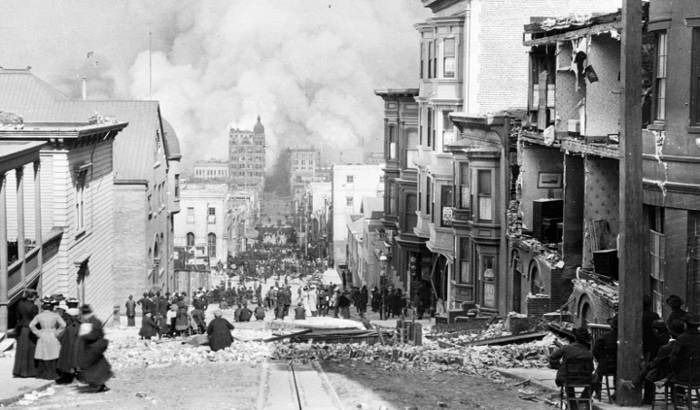
After the great San Francisco earthquake of 1906
► For vocabulary guide, see below.
California is known all over the world for its size, its sun, and its surf, its glamour and its optimism. But it is known too as "Earthquake Country " - a truly vulnerable region where big devastating quakes have occurred in the past and will happen again. It is unlikely that a disaster on the scale of recent disasters in Turkey or Japan could occur in California; California has learnt from its past disasters, and most buildings are designed to withstand major quakes. Nevertheless, Californians are worried. When will the next big quake strike the state, and where will all the shaking and crumbling and rocking begin?
Nobody knows for sure, but at all times California is on the alert. There could be an earthquake in California today. Consequently the earth is permanently monitored with high-tech seismographs situated in universities and government research stations; they are constantly watched by highly-trained employees and volunteers from the California Office of Emergency Services; and students in every school receive training in what to do in the event of* an earthquake.
Working at Menlo Park, near Stanford University, in the middle of "Earthquake Country", scientists from the United States Geological Survey are always monitoring and studying fault systems, and trying to predict where earthquakes are going to take place next.
Back in 1988, a team of USGS scientists completed a ten-year survey on "earthquake possibilities", and came up with the conclusion that there's going to be a lot of shaking in the years ahead. In particular, they predicted a 50% possibility of an exceptionally big quake of 8.3 sometime before 2018, somewhere along the San Andreas or Hayward faults. It has not come yet.
In the two centuries from 1812 to 2012 , California has suffered dozens of earthquakes. The last seriously damaging earthquake was the 1994 quake in the Los Angeles area, that registered 6.7 on the Richter scale, and did up to $40 billion worth of damage. A much stronger quake, of 7.2 on the Richter scale, struck Baja California (Mexico) in 2010, doing over a billion dollars worth of damage in this far less populated area.
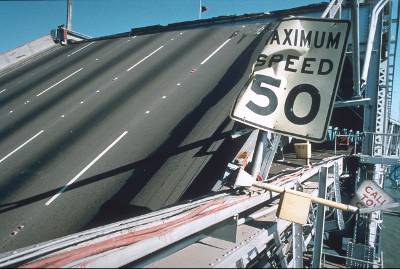
This highway bridge near San Francisco collapsed in a 1989 earthquake
Since 1812, California has experienced 15 major earthquakes of a magnitude of 7.0 or larger. Two of these were the great quake of 1857, with an estimated magnitude of 8.3, and the great earth-quake of 1906, which nearly levelled the port city of San Francisco and had a magnitude estimated at 7.9 to 8.2.
Responsibility for California's earthquakes lies in the fact that the state sits atop the famous and terrifying San Andreas Fault. This fault rocks and quakes often and unexpectedly as the earth's tectonic plates shift along fault lines that run 700 miles from the Mexican border to the north California coast. It is almost unbelievable that more than 20 million people should choose to live along this fault; but because their state has prosperity, an ideal climate, and a wonderful ambiance, Californians take a laissez-faire attitude to the potential danger.
Living in the hills above the Hayward Fault, I know all about the danger. Like many Californians, I buy costly earthquake insurance for my home. If I walk along certain streets in the town of Hayward, I can see how the earth creeps and shifts. In some places, the town looks as if the architects and builders made big mistakes in construction, because the buildings are out of kilter.

Actually, what has happened is that the streets have cracked and shifted, so that curbs no longer meet. Houses have shifted, so that walls are uneven. Buildings have interior and exterior cracks that can't be prevented, because the slowly shifting earth causes an inexorable movement in foundations, walls and streets! Geologists believe that displacements along this fault have been occurring for 15-20 million years. The drift can be measured - in the present decades - as a displacement of two inches per year, on average. It doesn't take an expert to figure out what moving part of a building two inches a year will do to that structure. During the destructive 1906 earthquake, in some places the earth moved as much as 21 feet!
Scientists now know that major earthquakes occur at about 150-year intervals along the San Andreas fault; but in the future, they will probably not happen unannounced. Scientists can now better predict when a quake is coming, by foreshocks and other techniques discovered in the studies they are constantly undertaking, so Californians can normally fo to bed at night without worrying whether the house will fall down around them while they are sleeping.
Still, with or without a warning, the next Big One, when it
comes, will still do enormous damage. It's something that we
Californians just live with.
WORDS
survey: study - prediction : talking about the future - strike: hit, happen - vulnerable: at risk - unlikely: improbable - withstand: resist - monitored: watched - seismograph: apparatus that detects movements in the ground - training: instruction - downtown: central - shift: move - to creep: move slowly -out of kilter: not in a straight line - curb (American English): -kerb (British English) edge of the road - inexorable : unstoppable, inevitable - drift: movement - two inches: about 5 cm.Printing: Optimized for printing
Copyright © Linguapress. Do not copy this document to any other website
Copying permitted for personal study, or by teachers for use with their students
STUDENTS' WORKSHEET - printable
California - waiting for the Big One
Interactive gap-fill exercise. Use on screen or on paper : word endings
Replace the missing word-endings in the following two extracts
from the article.
(To save your answers, take a screenshot when you have completed the
task)
Actual, what has happen is that the streets have
1. Why are building disasters on the scale of recent earthquakes in Japan or Turkey unlikely in California?
2. Who helps continuously monitor high-tech seismographs across California?
3. What did USGS scientists at Menlo Park predict in their 1988 survey?
4. How much damage was caused by the 1994 earthquake in the Los Angeles area?
5. Why do over 20 million people choose to live along the dangerous San Andreas Fault line?
6. Why do some streets and buildings in Hayward appear as if builders made big mistakes?
7. What is the average annual displacement rate along the Hayward fault in recent decades?
8. How far did the earth move in some places during the famous 1906 San Francisco earthquake?
9. According to scientists, how often do major earthquakes typically occur along the San Andreas fault?
10. How are scientists now better able to predict when an earthquake is coming?
Creative writing
Imagine that you are a journalist in 1906. You have just arrived in San Francisco, a short time after the earthquake. Describe the scene that you see - the scene shown in the top photo - and what some of the people in the picture have told you.
Alternatively : divide students into pairs, and have each pair script an imaginary interview between a journalist who has just arrived in San Francisco, and a local inhabitant, just after the 1906 earthquake.For teachers:
Language point
In the event of.... Many students, and indeed lots of native speakers, confuse the expressions in case of and in the event of.Note the sentence Students in every school receive training in what to do in the event of an earthquake. If we were to replace in the event of by in case of, the sentence would have a completely different meaning, and would be wrong. It would mean that students are trained to take preventative action just in case an earthquake should occur; what it really means is that students must know what to do if and when an earthquake occurs. See more examples on Problem words - in case of.
Grammar - the passive
The text provides multiple examples of use of the passive voice (present & past) Because the text focuses on scientific monitoring, geographical processes, and historic events where the agent is secondary or generalized, passive structures appear frequently across multiple tenses. This is typical of (semi)-techincal writing
Continuous forms: "displacements [...] have been occurring" / "studies they are constantly undertaking"
Past Simple: "most buildings are designed to withstand major quakes"
Compound nouns
Compound nouns are common in fairly formal English: a compound noun is formed when one noun serves as an epithet (like an adjective), to define or explain the following noun. Students need to realise how easy they are to create !"Earthquake Country" (noun earthquake describing country)
"Research stations" (noun research modifying stations)
"Fault systems" and "Fault lines" (noun fault modifying systems / lines)
"Gas station" (noun gas explaining what kind of station is meant)
"Earthquake possibilities" and "Earthquake insurance"
"Port city" (noun port describing the nature of the city)
Adverbs
This text is very rich in all varieties of adverb: here are examples, grouped by type: note the position of adverbs in the sentenceClick link for more on the position of adverbs in English.
Adverbs of manner (how something happens... often qualifying an adjective)
constantly ("they are constantly watched")
highly ("by highly-trained employees")
seriously ("seriously damaging earthquake")
unexpectedly ("quakes often and unexpectedly")
slowly ("slowly shifting earth")
unannounced ("happen unannounced")
Adverbs of time, frequency & aspect (when or how often)
permanently ("permanently monitored")
always ("always monitoring")
next ("take place next")
yet ("has not come yet")
often ("rocks and quakes often")
now ("Scientists now know")
normally ("can normally go to bed")
Adverbs of degree, focus & intensity (to what extent)
Back ("Back in 1988")
far ("far less populated area")
less ("far less populated area")
nearly ("nearly levelled the port city")
almost ("almost unbelievable")
no longer ("curbs no longer meet")
better ("can now better predict")
still ("will still do enormous damage")
just ("we Californians just live with")
Adverbs of place & location (where)
sometime ("sometime before 2018")
somewhere ("somewhere along the San Andreas")
north ("north California coast")
there ("while they are sleeping there")
Sentence / disjunct adverbs (attitude or transition)
Actually ("Actually, what has happened is...")
Still ("Still, with or without a warning...")
probably ("will probably not happen")
when ("predict when a quake is coming") (interrogative/relative adverb)
Answer to multiple choice exercise: 1B / 2C / 3A / 4B / 5C / 6B / 7A / 8C / 9B / 10B

 Copyright
information.
Copyright
information.