
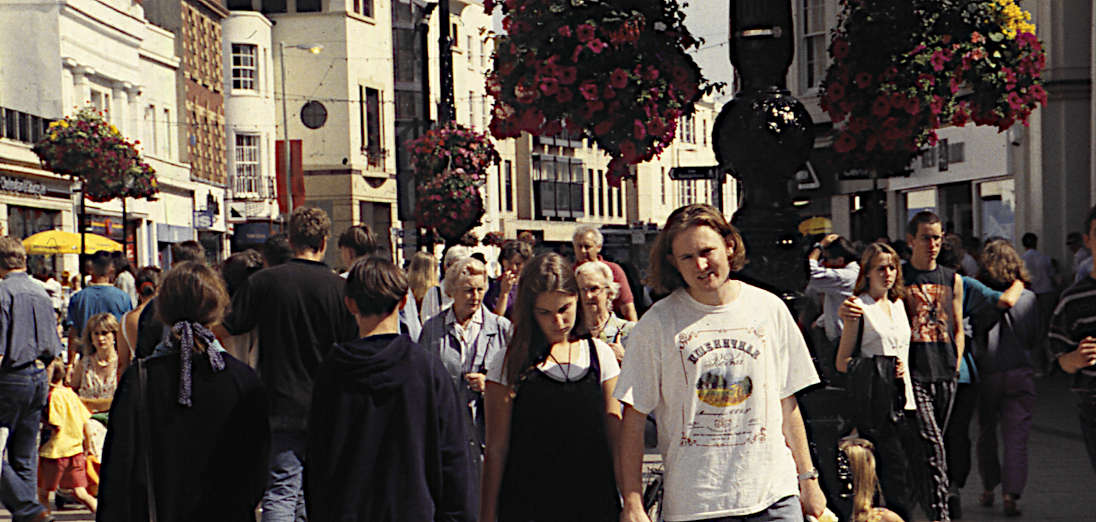
The rise and fall of the English High Street
And what of the future?
Advanced level English
More words - comprehension: phrases and meanings - in fourteen cases, select the best equivalent for the words or expressions in bold type from the dropdown list of alternatives. You can remove the dropdown boxes by clicking this button.
For generations, the High Street was the undisputed beating heart of any English town or small city. More than just a place to shop, the High Street was a social crossroads where townspeople met, talked, chatted, and forged a local identity. Today, newspaper headlines frequently lament the "death of the High Street," pointing to boarded-up shopfronts and empty department stores. To understand how we arrived at this crisis, we must look at how the "High Street" evolved, stumbled , and began transforming for the modern age.
The origins of the High Street
Before the "High Street" existed, shopping habits were entirely different from those of today. Towns relied on weekly markets and seasonal fairs held in open squares. However, as populations stabilized during the late Middle Ages and early modern period, traders began to set up in fixed places, positions.
The term "High Street" historically designated a town's most important thoroughfare – the one around which the town had grown up. Merchants converted the ground floors of their homes into permanent shops with fixed tables where goods are sold. These early high streets were chaotic mixtures of butchers, bakers, and candlestick makers, not to mention pubs, inns, serving the needs of the local community.
The heyday of High Streets
The Industrial Revolution transformed the High Street from a functional marketplace into a glamorous destination. Between 1750 and 1950, urban populations exploded, and a rising middle class found itself with extra money to spend and new leisure time. Specialist stores appeared: chemists, clothing shops, paper and writing material shops, newsagents, and more. And as high streets became paved and fitted with gas (later electric) street lighting, large plate-glass windows turned a a gentle walk into a window-shopping experience. Provincial high streets strove to echo innovations that had developed on a grander scale in London.
In the mid-19th century, London was in a class of its own – a shopping hub for the nation, and eight times bigger than any other English city. London pioneered department stores, large shops selling everything from food to furniture. The world's first, Harding, Howell & Co., opened in 1796, and giants like Harrods and Selfridges followed soon after. In the 20th century, stores like Marks & Spencer and Debenham's expanded nationwide, bringing a taste of the London experience to High Streets across Britain.
Crucially, this golden age, peak time was fueled by the golden age of public transport. The expansion of the railways, followed by electric trams and omnibus networks, meant people from outlying suburbs and villages could easily travel into the town centre. The High Street became a central hub, perfectly positioned at the intersection of local bus routes.
The start of the decline
The
first major crack in this model appeared in the 1960s, driven by a
dramatic shift
in mobility. As the motor car transformed from a
luxury item for the wealthy into
an everyday necessity, the traditional centralised layout of English
towns, formerly an asset
,
became a liability
.
Historic centres simply had not been built to
handle traffic congestion or
provide adequate parking.
Developers
looked to the United States for inspiration and introduced the first
out-of-town superstores and shopping
centres. These enclosed,
climate-controlled complexes offered free parking and a predictable
shopping environment. For
families with cars, driving to a suburban shopping centre was
far more convenient than fighting for a parking
space on a
congested town-centre street.
Slowly, the exodus began.
The Double blow, trouble: Superstores and E-Commerce
If the 1960s caused a slow leak , the late 20th century delivered a devastating double shock, hard hit to traditional town centres.
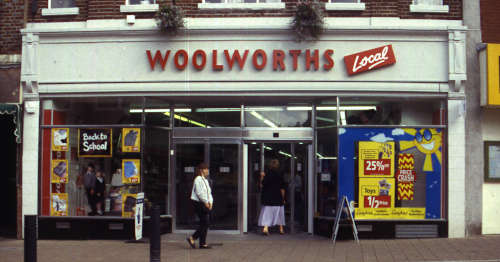
.Woolworths - once a familiar High Street name
First came the rise of massive out-of-town out-of-town shopping areas and giant superstores in the 1980s and 1990s. National chains like Tesco, Asda, and Sainsbury’s expanded, offering ample free parking space and selling groceries alongside clothes, electronics, and books. Local high street shops shut down, unable to compete with the scale and rock-bottom prices of superstores.
Then the explosion of online shopping in the 2000s removed the need to travel altogether. Armchair shopping had arrived. Next-day delivery proved to be the breaking point for dozens of historic retail chains, and high-profile financial failures left massive gaps on English High Streets as iconic names like Woolworths, Timothy Whites, Dewhurst, and BHS closed down completely
The current mix: survival and adaptability
Yet despite grim predictions, the High Street has not vanished; after all, how could it? Instead, it is entering a radical new phase where retail shopping is no longer the main attraction. Today’s High Streets boast a completely different mix of tenants . Space once occupied by clothing chains is now filled by services that cannot be automated or taken online: hair salons, coffee shops, tattoo parlours, and boutique gyms. Independent specialist stores, shops, like artisan, traditionally made beer shops, artisan bakeries, charity shops and vintage boutiques, thrive by offering unique products and personalized expertise that
algorithms cannot replicate.Furthermore, the modern high street has transitioned into a dining destination. Cafes, fast-food outlets, and upmarket restaurants have taken over, turning the town centre back into what it was centuries ago: a place for social interaction rather than just a place to go shopping.
The Outlook
The future of the High Street depends entirely on reimagining its purpose , and the outlook is not entirely bleak . The most successful High Streets of tomorrow will be mixed-use spaces. Forward-thinking town councils are already converting empty department stores into residential flats, community hubs, and co-working spaces. By bringing people back to live and work in the town centre, they create a built-in customer base for local businesses. The High Street is not dying; it is shedding its 20th-century skin to become a more community-focused, flexible space for the 21st.
WORDS:
Click the button at the top of the page.
Note: " butchers, bakers, and candlestick makers." This is based on a fixed rhyming expression, taken from the world of nursery rhymes.
The butcher, the baker, the candlestick maker, And all of them out to sea.
Printing: Optimized for printing.
Copyright © Linguapress 2026 Do not copy this document to any other website
Copying permitted for personal study, or by teachers for use with their students
LINGUAPRESS ADVANCED ENGLISH - STUDENT WORKSHEET
The English High Street
Exercise 1. Missing
words - mostly compound
nouns
Most, but not
all, of the words missing from this extract from the article
are compound nouns. In some cases they are written as single words, in
other cases two or three words. In each case, the first letter of the
missing word or words is there, for example [d i], to help you remember.
Note how some compound nouns are written as a single word, others as
two or even three words. There is no fixed rule about when to use hyphens.
In the mid-19th century, London was in a class of its own – a [s h] for the nation, and eight times bigger than any other English city. London pioneered [d s] , large emporiums selling everything from food to furniture. The world's first, Harding, Howell & Co., opened in 1796, and giants like Harrods and Selfridges followed soon after. In the 20th century, stores like Marks & Spencer and Debenham's expanded [n] , bringing a taste of the [L e] to High Streets across Britain.
Crucially, this [h] was fueled by the golden age of public transport. The expansion of the railways, followed by electric trams and [o n] , meant people from [o] suburbs and villages could easily travel into the [ t c] . The High Street became a centralized hub, perfectly positioned at the intersection of local [b r]
Exercise 2 - True or false questions:
- True or False: Before fixed shops existed, trading in English towns was mainly concentrated around weekly markets and seasonal fairs.
- True or False: The historical term "High Street" originally referred to the highest road in a town.
- True or False: The Industrial Revolution marked the peak period where high streets became glamorous destinations .
- True or False: The world's very first department store opened in London during the mid-19th century.
- True or False: The growth of public transport networks like railways and trams allowed more people to shop in the High Street.
- True or False: In the 1960s, the increasing popularity of cars became an advantage for historic town centres.
- True or False: Out-of-town shopping centres built in the late 20th century were heavily inspired by developments in the United States.
- True or False: In the 1990s, local high street shops struggled against online superstores .
- True or False: On modern high streets, independent speciality shops are finding success by focusing on unique products and personal expertise.
- True or False: The article suggests that tomorrow's high streets will recover by bringing in new department stores..
For teachers
Ideas for the classroom - vocabulary and grammar
This text is very rich in vocabulary, particularly the vocabulary of the urban environment. It is also particularly rich in compound nouns, a type of noun that is commonly used in semi-technical writing.Grammar - Sentence structure
Pay particular attention to the first three paragraphs of this article. Can you students see any difference? It should be clear; almost all the sentences in the first two paragraphs start with a "front loading" or introductory phrase or clause; the main clause of the sentence, starting with the subject, is in second place.In this first paragraph, the sentences begin with 1. an adverb phrase of time, 2. a modifying noun phrase, 3. an adverb (Today) acting as a sentence adverb, 4. An infinitive phrase of purpose. Each of these introductory phrases could be put at a different point in the sentence, but the writer puts them first in order to set the situation before describing the action.

 Copyright
information.
Copyright
information.