
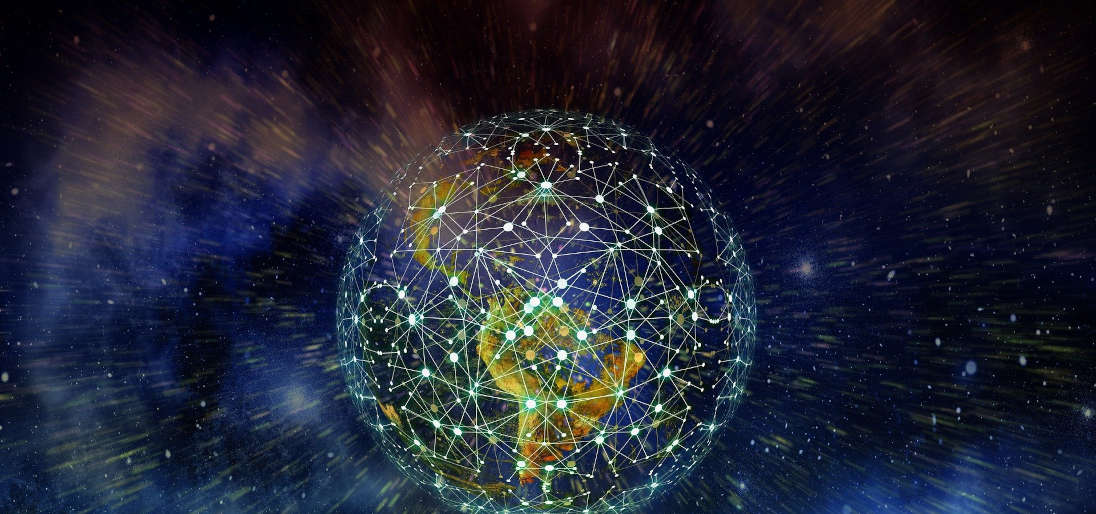
What if the Internet collapsed?
And yes, it could happen !
Advanced level English
WITH AUDIO. ►: Click to open/close audio player
Vocabulary guide below - or else click on any words in purple for instant help.
By Al Nebi
Shock! Horror ! "The Internet's down", "My phone's died!" "I can't log on", "Help! The GPS screen's gone blank!" "My credit card doesn't !" ........ Most of us have experienced moments like this, when something we depend on is no longer there to help. It's frustrating, alarming, maybe even frightening.... but after a few minutes or a few hours or a few days, everything gets back to normal. We can relax again. There was an Internet outage.... but it was only local, or it just affected some services or some apps; order was restored before our life descended into chaos or calamity.
 The
connected world.
The
connected world.But what if the Internet were to go down? Not locally, but worldwide? And what if engineers were unable to get it going again within a very short space of time? Could it happen? And what would happen if it did? The honest answer is that nobody knows.... There are no experts on the subject, because a global failure of the Internet has happened. On the other hand short-lived and local outages have happened, for example in Spain or in parts of the USA, and these events have given us a quick picture of what might happen if (some say when) the whole Internet were to collapse, all over the planet. But could this really happen?
Many optimists argue that the Internet is too uncentralized, too adaptable, reactive, to collapse, stop working on a global scale - even on the scale of a continent. Past experience, they say, shows that systems can be back up online again within a few hours, or at worst a few days, and life can then carry on again as normal. But past experience has only concerned local issues, regional systems or specific corners of the Internet, not the whole system.
Among leading systems engineers, there are also now a growing number of pessimists – maybe we should call them realists – sounding the alarm, saying that a global of the Internet is not impossible. And as science-fiction writer and philosopher Arthur C. Clarke famously said, "What is possible is inevitable" .... This may or may not be true... yet the fact is that a global collapse of the Internet is not impossible. It could happen. And if the Internet did collapse, what would that mean for us? Would be affected? The simple answer is yes !
If
you thought that Covid caused a big change in your life, imagine the
day when the Internet really does go down. No region,
company, or
satellite system will be able to connect. Everything will be down, and
in spite of frantic attempts to restart or reroute data, the terrible
truth will soon be clear. The Internet has failed, and it's not coming
back any time soon. If ever.
The immediate
effects will be severe. Financial systems will fail because
21st-century digital banking and online transactions depend entirely on
Internet connectivity. Unable to pay bills or get
, unable
to
access their databases, businesses will come to a stop. logistics
systems
will fail as transport companies lose access to GPS systems
and
their delivery timetable, planning.
Within hours or days, shops and fuel stations
will run
essential
goods, after first having to limit sales to
"cash only".

International travel and trade
will rapidly come to a stop due to the
of online navigation and
coordination tools. Hospitals will be in chaos as digital data, information
become inaccessible, and high-tech equipment from MRI scanners to
digital control panels stop working. All over the world, governments
will declare states of emergency, coordinating responses using
emergency, reserve communication
technologies
radio, television,
and telephone land lines.... where they still exist. In many
parts of the world, the struggle for survival will collapse into
anarchy and local conflict. Here and there, a few survivalists, people preparing for the end of
society, living
with no connections to public services,
will be pleased that their preparation was not all in
;
but even their lifestyle will be affected.
After the initial panic, societies will begin to adapt. Local networks
will be set up to support limited data exchange within cities
or
regions. People will return to a lifestyle like that which existed
until the 1990s, using printed materials, real money, and
face-to-face communication.
As for the digital economy – from
social media to online shops selling to the public, the opposite of
wholesale
– it will have disappeared. Many
organizations will have lost all the critical data that was stored only
in the "cloud" .... accessible only by Internet. Education
will
go back to traditional methods, relying on printed textbooks and direct
instruction.
On the plus side, there will be
positive outcomes as the world struggles to adapt to the new
reality . Energy consumption will be lower as data
centers have had to shut down; cybercrime and online
misinformation
will have disappeared, and life will maybe feel less stressful without
the
constant pressures from digital distractions and social media.
Over time, the world will reorganise around smaller, independent
communication networks and direct human cooperation. The loss of the
Internet will mark the end of global digital integration, but
will
also bring in a new technological
focused on resilience, local
autonomy, and physical systems.
WORDS:
SatNav: satellite navigation system - rely (note the pronunciation): depend - glimpse: view - resilient: reactive - to fail: to stop working - grind to a halt: slowly stop working - supply chains - the logistics of distribution - schedules: programmes, timetables - records: recorded information, data - preppers: people who are preparing for the end of civilisation - off-grid: with no connections to public electric or water systems - retail: selling to the final consumer. Printing: Optimized for printing.
Copyright © Linguapress 2025. Do not copy this document to any other website
Copying permitted for personal study, or by teachers for use with their students
LINGUAPRESS ADVANCED ENGLISH - INTERACTIVE WORKSHEET
What if the Internet really went down?Interactive: Multiple
choice comprehension questions :
Reading skills - Read
the text carefully, then decide which answer is correct for each of the
following questions
- A. To explain the technical reasons behind Internet outages
- B. To create a realistic context that contrasts with a more serious scenario
- C. To criticize people for depending too much on technology
- D. To show that most Internet outages are caused by human error.
- A. It has happened before only once or twice
- B. Experts refuse to study the possibility
- C. No full-scale global failure has ever occurred
- D. Governments keep data about outages secret.
- A. Past outages were caused by governments, while a global collapse would be natural
- B. Past outages have only affected limited areas, unlike the global failure imagined
- C. Past outages were more serious than most people realized
- D. Past outages demonstrated how resilient local systems actually are.
- A. Their concerns are probably exaggerated
- B. They believe they can fix the Internet faster than others
- C. Their warnings may be more based on technical knowledge, than other more optimistic views
- D. They do not understand how the Internet works.
- A. To argue that Covid permanently damaged digital systems
- B. To show that people have already lived through a similar technological disaster
- C. To suggest the Internet collapse would be even more disruptive than Covid
- D. To highlight how pandemics spread faster due to online misinformation.
- A. An increase in cybercrime
- B. The shutdown of financial transactions
- C. The reorganisation of local communication networks
- D. The decline of social media.
- A. They are independent of digital systems
- B. They are dependent on GPS and Internet connections
- C. They are prepared for long-term Internet failures
- D. They function better without digital technology.
- A. They would want to avoid surveillance through the Internet
- B. These systems are faster than digital ones
- C. Most modern communication tools would no longer function
- D. International organisations would forbid the use of digital networks.
- A. People will quickly rebuild the Internet exactly as it was
- B. Societies will return permanently to pre-industrial practices
- C. Localised, limited networks and older forms of communication will emerge
- D. Adaptation will be impossible due to loss of digital data
- A. Cynical, suggesting that humanity cannot cope without the Internet
- B. Hopeful, focusing only on the benefits of losing the Internet
- C. Balanced, acknowledging both the losses and potential for resilience
- D. Sarcastic, implying that concerns about digital collapse are ridiculous
For teachers
Using the text in classTwelve words are missing from the text; students should choose the correct (best) option from che choices in each dropdown box. This exercise can either be done as students read the text for themselves, or else as they listen to it, and note down the missing words as they go.
Grammar: Conditionals
In particular, note all the uses of conditional structures, notably hypothetical / unreal situations, which discuss events that might happen but are not guaranteed.
Examples from the text:
- “But what if the whole Internet were to go down?” – second conditional, hypothetical scenario.
- “Could it happen? … It could happen.” – conditional possibility.
- “What would happen if it did?” – conditional result of an unreal event.
Teaching note: Note the use of if + past subjunctive (were to), rather than went... a verb form that stresses the hypothetical nature of the event.
Modal verbs
This text contains many examples of predictions, covering ability, possibility, or probability. Key modals in the text are could, might, would, should.
Examples from the text:
- “ What might happen if ... the whole Internet were to collapse” – might shows uncertainty.
- “It could happen.” – could shows possibility.
- “Would everyone be affected? The simple answer is yes!” – would expresses a hypothesis.
- “Past experience shows that systems can be brought back up online…” can expresses ability.
Use of the future with will
The future in English is not commonly expressed using will, except in this kind of article, a written document predicting things to come. For other ways of expressing the future, see Linguapress English Grammar Expressing the future.
Examples from the text:
- “The immediate effects will be severe.” – future simple.
- “Financial systems will fail…” – future simple.
- “International travel and trade will rapidly come to a stop…” – future simple.
- “Hospitals will be in chaos…” – future simple.
- “Over time, the world will reorganise around smaller, independent communication networks…” – future simple.
- “Life will maybe feel less stressful…” – future simple.
- “Many organizations will have lost all the critical data…” – future perfect.
- “Cybercrime and online misinformation will have disappeared.” – future perfect.
The Internet is down / the Internet is off / the internet is out..... There are slight nuances in meaning between the three adverbial particles... though all basically mean that there is no Internet. Down tends to suggest something temporary, the Internet will be back up soon. Off tends to suggest something deliberate, as in "it's been turned off". Out may suggest something more permanent
Discussion
This text features a topic on which students are liable to have differing views. Divide your class into pairs, or groups of four students, and have them discuss the subject. For each group there should be someone to argue that the Internet will never collapse, and must never collapse, someone else to argue that it will or may collapse, and that that will be a good/bad thing. The amount of electricity required by datacenters is becoming a new point of tension: in the UK and the US, datacenters now (2026) use over 6% of the national electricity supply, and the figure is growing fast.... largely to satisfy our need to stream movies, use AI and social media, store trillions of selfies... and of course other more important things too.
===============
Answers to the Multiple choice Comprehension exercise: 1B, 2C, 3B, 4C, 5C, 6B, 7B, 8C, 9C, 10C


 Copyright
information.
Copyright
information.