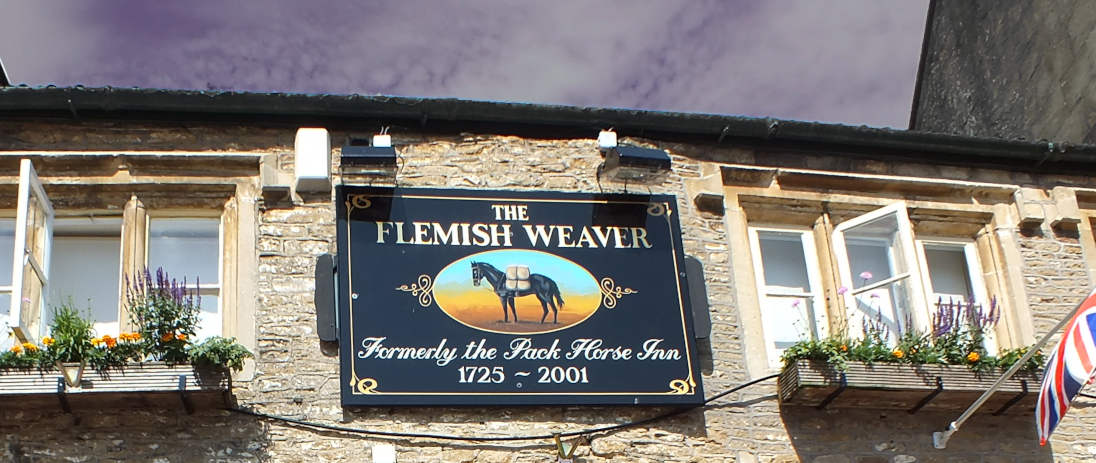
English Pubs and their Signs
Each sign tells a story
The history of the pub goes back a long way — and of course much further than general literacythe ability to read and write. It is only during the last century and a half that the majority of people in Britain have been able to read at least simple words; until then, any commerce wishing to identify itself, be it shop or tavern, had to make use of symbols or sign language. Yet while barbers' shops in Britain were all identified by red and white striped poles, and chemists' by large glass bottles of coloured water, the situation was different with pubs.
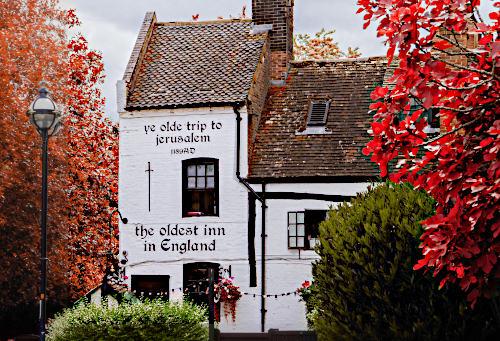 The Olde Trip to Jerusalem is said to be the oldest pub in England.
In the olden days, many "inns" and "taverns", the predecessors of today's pubs, were cateringproviding what is necessary for for visitors and travellers, as well as local customers. The names they gave themselves, and the signs they hung up in the street outside their premisesbuildings were not just for decoration, but served as publicity, and to clearly identify one pub or tavern from the other.
While many of today's pubs are less than a hundred years old, almost each one still has its own distinctive name, and in many cases a fine sign to go with it. The oldest named pub in Britain is the Trip to Jerusalem in Nottingham, an old inn beneath the castle, where mediaeval knightssoldier on horse used to gather before setting out on the Crusades. Only a few English pubs, however, have names dating back more than three centuries. One of the more common names that does date back a long way is the Rose and Crown, a name first used just after the "Wars of the Roses" in the fifteenth century, when the House of Lancaster (emblemsymbol: a red rose) fought the House of York (emblem: a white rose) for the English crown. The name Rose and Crown has been a popular name for inns and pubs ever since.
A lot of older pubs have names reflecting local loyalties or loyalty to king and country. Inns situated near the homes of dukes and lords are frequently named after the duke's or lord's family name — especially when the duke or lord in question happened to ownby chance owned the inn, as was often the case. Thus a pub called the Norfolk Arms, whose sign shows a heraldic shieldcoat of arms or the portrait of a Duke, is likely to have been named after one of the Dukes of Norfolk (a title created in 1483).
As Britain's population expanded in the nineteenth century, so did the number of pubs, many new pubs taking names to celebrate military victories or victorious commanders. Following the Battle of Waterloo, the Duke of Wellington became a popular pub name, and fine portraits of the "Iron Duke" still adorn many English pubs.
Britain's statuscondition as an island nation is clearly illustrated by the large number of pubs called The Ship — not just in ports, but in inland towns as well. Each Ship has its own history; here the Ship was founded by a retired seaman, there it was an inn popular with seamen, and in other places just a nice name, though certainly not chosen without some justification. In some places, pubs are named after specific ships, or specific incidents related to the sea; two of the oldest pubs in England fall into this category, the Mermaid in Rye, named after the mythical figure half-fish, half-woman, about which sailors used to love "spinning yarns"; and the Ship and Turtle in Chester, the origin of whose name remains a mystery!
Local industries or activities have given rise to many pub names. Many university towns boasthave a College Arms, catering principally for students and staff alike; and many villages contain pubs called the Plough or the Boarwild pig's Head.
Not all pubs, however, have ancient names. A pub in Bristol which opened in the 1970's, is called the Man in Space, and its sign depicts an American astronaut. In the small town of Boston, in the east of England, there is a pub called the Boston Blitz, with a sign showing a man playing American football; though the sign is new, the name of the pub reflects the history of this small town, from which settlersperson who establishes his home in a place crossed the Atlantic four centuries ago, to found the city of Boston, Massachusetts.
Pub signs have been described as Britain's finest free art collection, and that is not a bad description. Some, though not all, are real works of art, due to skilled artists and craftsmen. Stanley Chew, who died in 1997, produced over seven hundred signs, which are now collectors' items.
Some people are worried, however, about the future of pub signs; the big breweriesfirm or building where beer is made, who own most of Britain's pubs, have begun standardizing some of their outletspoints of sale, and replacing the old names with standard ones, such as the Harvesterbring in agricultural produce when it is ready, frequently with no pictorial sign. A minority of pubs have thus lost their identity, as they have been converted into mediocre mass products; yet the majority of English pubs still hold on to their distinctive names, and in many cases their fine signs. English pubs are a fine tradition, with imitations all over the world; and no self-respecting imitation would consider itself authentic without a painted sign!
Surprising pub names
Most pub names are fairly easy to understand; but some are quite strange, until you know how they originated. There are some pubs called the Bag of Nails... which sounds strange, until you learn that "Bag of Nails" is a distortion of "Baccanales".... which means drinking sessions, after the Latin god of drinking Bacchus. Then there is the well-known Elephant and Castle in London. What an odd name ! But actually, the name is perhaps a distortion of "La Infanta de Castilla", a title given to the first wife of King Edward 1st.Printing: Optimized for printing
Copyright © Linguapress. Do not copy this document to any other website
Copying permitted for personal study, or by teachers for use with their students
STUDENTS' WORKSHEET
Pub signs - definite and indefinite article usage
Complete the following extract from the text, adding articles whenever they are necessary. If no article should be used, choose 0.lot of older pubs have names reflecting local loyalties or loyalty to king and country. Inns situated near homes of dukes and lords are frequently named after duke's or lord's family name — especially when duke or lord in question happened to own inn, as was often case. Thus pub called Norfolk Arms, whose sign shows heraldic shield or portrait of Duke, is likely to have been named after one of Dukes of Norfolk ( title created in 1483).
Reading exercise
Pub signs are a fascinating form of popular culture, and this article should interest most students.So students, read through this article on your own and note down:
* five language points or words you are not sure of.
* five facts about English pubs that you have learnt from the article.
Grammar:
For a clear presentation of the use of articles and quantifiers in English, see A Descriptive Grammar of English: Modern English grammar by example - pages 98 - 112. (new edition 2023).
More details ISBN 979 - 8851404597.
 Copyright
information.
Copyright
information.