
Rocking Britain, and how it all began
A short history of rock and pop music in Britain
Linguapress
Advanced level English
The
story of British rock and pop isn't just about music, it’s
about
how a rainy island off the north coast of Europe took American blues
and rock and roll, gave them a fierce British attitude, put
the resulting music at the
heart of new lifestyles, and sold it to the world. In short,
the story of British rock
is all about how groups of young people with cheap guitars
have shaped modern society.
Words:
click any word in red to see its meaning
- synonym or explanation.
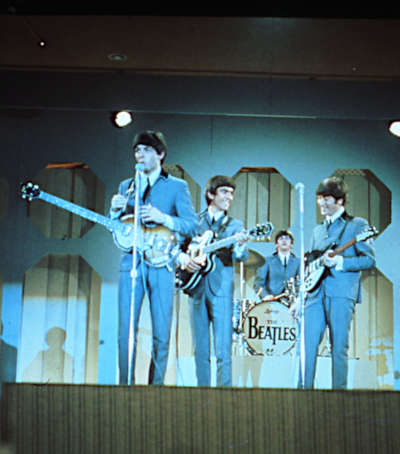
The Beatles, in the early 1960s
In the beginning there was Skiffle
In the dreary, post-war 1950s, there were no such things as youth culture or the generation gap. Young people lived like their parents, dressed like their parents and listened to the same music as their parents. That changed in the space of a couple of years when an American band called Bill Haley and the Comets burst onto cinema screens in the controversial film Blackboard Jungle, playing the first anthem of rock 'n' roll, "Rock Around the Clock." It was fast, loud, and wild. When the film eventually came out in London, Teddy Boys* literally tore up cinema seats. Rock and roll had arrived in BritainThe Comets used new-fangledrecently invented; modern electric guitars, but these were unavailable in the UK. To get round the problem, British kids invented Skiffle. Led by Lonnie Donegan, kids set up groups using whatever they could find: acoustic guitars, old washboardstextured metal boards used for washing clothes for drums, and a broomstick attached to a wooden tea-chest for a bass. It was cheap, it was fast, and anyone could do it. Skiffle was the first DIYDo-It-Yourself; homemade music crazefad; wildly popular trend, and it taught a generation of aspiringhoping to become successful musicians how to play.
Soon, Britain produced its first homegrown rock star and pop group, Cliff Richard and the Shadows. Cliff was Britain's answer to Elvis – a bit edgy, but respectable enough for parents to put up with. The Shadows pioneered the classic rock line-up: lead guitar, rhythm guitar, bass, and drums. Their smooth guitar instrumentals set the standard for every British group that followed.
Merseybeat - pop moves north
By the early sixties, the music scene shifted north to Liverpool. London was the cultural capital of Britain, producing many top groups like the Rolling Stones; but Liverpool was Britain's doorway to and from the USA, and the city most in tune with the new music from across the Atlantic. Sailors fed Liverpool with a unique supply of American records, R&B*, soul and rock 'n' roll, that was unavailable anywhere else in the UK. The result was Merseybeat, a catchymemorable; easy to remember, energetic sound with a heavy beat and great vocal harmonies.At the top of the pile were The Beatles. John, Paul, George and Ringo started out playing Skiffle before conquering Liverpool's Cavern Club. After initially copying American R&B, they soon began to innovate, writing their own songs full of infectious energy. In 1964, they went to America and blew the roof off The Ed Sullivan Show, sparkingtriggering; setting off the "British Invasion." Suddenly, British bands were selling a British version of American music back to Americans, and the world went crazy for it.
Liverpool was a goldmine. Gerry and the Pacemakers and Herman's Hermits scored massive hits with their cheerful, melodic pop; yet it was largely a guy's world, in an age when the word "guy" only referred to men. One of the first girls to make a name in pop was Lulu, with her all-male band the Luvvers. Literally and figuratively, young people couldn't get enough of the new pop music, since recordsvinyl music discs weren't cheap and there was not much pop on the radio. The "radio" in those days meant the BBC, which had a monopoly over broadcastingtransmitting radio programs. The BBC's popular music station, the Light Programme, was stuck into dance band music, and hardly touched pop. Fortunately, radio waves, like ideas, can cross frontiers, and millions of teenagers tuned inlistened each evening to Radio Luxembourg, a commercial station broadcasting straight from the Continent into their bedrooms. Before long, "pirate" radios came on the scene, broadcasting non-stop pop from ships anchored in international waters off the coast. There was no stemming the tide.
Louder and Heavier
As the 1960s turned into the 1970s, musicians got tired of simple three-minute pop songs. They wanted to see how far they could push their instruments and stretch their creations. Some, like the Nice, went down the "artistic" route, mixing rock with classical symphonies, using roaring keyboardselectronic piano instruments to create a massive, dramatic sound that would lead to "progressive rock."Others just wanted to multiply the decibels. Led Zeppelin took old American blues, amplifiedincreased the volume of the amplifiers, and added heavy drums and soaringflying high; powerful vocals. They became the ultimate stadium rock gods, traveling the world in private jets and changing the face of rock forever.
Meanwhile, in the industrial city of Birmingham, Ozzy Osbourne and Black Sabbath came up with heavy metal – dark, spookycreepy; ghostly music, perfectly reflecting the tough, factory-dominated world of the age.
And then came Punk
Nevertheless, by the mid seventies, rock music was becoming over-commercialized. Business interests had jumped on the bandwagon, while the new big name rock stars were millionaires living in mansions. Many ordinary kids, facing growing social problems such as unemployment and limited opportunities, felt that established pop and rock musicians were out of touch. They were angry, and they wanted their music back.The result was Punk. The Sex Pistols put the cat squarely among the pigeons. They couldn't play their instruments very well, but they didn't care. They sworeused bad or offensive language on live TV, insulted the Queen, and stripped rock music down to three loud chordsharmonies and basic rage. They proved you didn't need to be a virtuoso to be in a band..... as their parents' generation had been saying all along!
Punk quickly split into cool new directions. The Clash took its rawunrefined; rough and powerful energy and mixed it with political lyrics and rockabilly; the Police combined punk's energy with a bouncy, reggae-infused pop sound that earned them massive hits worldwide.
So where are we now?
Since the wild days of the 1970s, British music hasn't just rested on its laurels. Groups became known as "bands" as the 1980s traded guitars for synthesizers, techno and flashy haircuts. The 1990s brought "Britpop," with bands like Oasis and Blur bringing back classic 60s sounds for a new generation, alongside a massive electronic dance music revolution.Today, the internet has changed the game, breaking down walls between genres. Modern British music is extremely diverse, ranging from the indie-rock of the Arctic Monkeys, to the street-level poetry of grimea fast-paced style of British electronic hip-hop and rap, and to global solo superstars like Adele and Ed Sheeran.
British music has always succeeded because of one simple trick and plenty of good marketing. It takes global sounds, gives them a unique British spin, and serves them back to the world, in a way that the world, it seems, finds irresistible.

WORDS:
new-fangled: recently invented; modern - washboards: old-fashioned boards used for washing clothes - DIY: Do-It-Yourself; homemade - craze: fad; popular fashion - aspiring: hoping to become successful - catchy: memorable - sparking: starting, setting off - records: vinyl music discs - broadcasting: transmitting radio - keyboards: electronic piano instruments - amplify: make louder - soaring: flying high; powerful - spooky: creepy, ghostly - swore: used bad or offensive language - chords: harmonies - raw: unrefined; rough and powerful - grime: a fast style of British hip-hop
* Extra words: Teddy Boys - a small youth subculture of the 1950s, young working-class men who wore very smart clothes. Teddy was a reference to the dandy styles of the Edwardian period (at the start of the 20th century).
R&B : rhythm and blues.
The changing meaning of words. Note how this article shows how language evolves, even over a relatively short period in time. In the 1960s, rock and pop musicians came together as groups, today they are called bands. In the 60s, the word guy designated only men, today it means people of either sex.
Damon Runyon's 1930 short story collection, called Guys and Dolls, came out as a film in 1955. But in the 2020s, the word dolls has taken on a different meaning.
Copyright © Linguapress 2026 Do not copy this document to any other website
Copying permitted for personal study, or by teachers for use with their students
More advanced English texts on Music on Linguapress:
- Bob Dylan - from small-town America to global icon. With audio
- Taylor Swift - the sensation of a generation With audio
- Woodie Guthrie. The Dustbowl baladeer.
- The Story of the Blues - with audio - by Robert Springer
- Mississippi music - - with audio Jazz, blues, soul, rock 'n' roll, and Elvis - they all originated in the Mississippi valley.
- John Lennon- Remembering the death in New York of the Beatle who changed the world..
LINGUAPRESS ADVANCED ENGLISH - STUDENT WORKSHEET
Rocking Britain, and how it all began
Exercise 1 - Idioms
Choose the correct meaning of the following idiomatic expressions that occur in the article:
1. set the standard
2. blew the roof off
3. was a goldmine
4. There was no stemming the tide
5. jumped on the bandwagon
6. were out of touch
7. put the cat among the pigeons
8. rested on its laurels
Working from memory, replace the words that are missing from this extract.
In
the dreary, post-war 1950s, there were no things
youth culture or the generation .
Young people lived their
parents, dressed
their parents and listened to the
music and radio stations
their parents. That changed in the
of a couple of years when an American band called Bill Haley and the
Comets burst cinema screens
in the controversial film Blackboard Jungle, the first anthem of rock 'n' roll,
"Rock Around the Clock." It was fast, loud, and wild. When
the film opened in London,
Teddy Boys literally up
cinema seats. Rock and roll
arrived, and older generations could not understand.
Exercise 3 - Word Formation
Complete the sentences below by transforming the base word in brackets into the correct form to exactly match the text of the article.
- ...an American band called Bill Haley and the Comets burst onto cinema screens in the film Blackboard Jungle...
- The Comets used new-fangled electric guitars, but these were in the UK.
- The Shadows the classic rock line-up: lead guitar, rhythm guitar, bass, and drums.
- The BBC's popular music station, the Light Programme, was stuck into dance band music, and touched pop.
- Before long, "pirate" radios came on the scene, non-stop pop from ships anchored in international waters off the coast.
- By the mid seventies, rock music was becoming
- Business interests had jumped on the bandwagon, while the new big name rock stars were living in mansions.
- serves them back to the world, in a way that the world, it seems, finds .
For teachers
Grammar -
1. as and like
Look at the first sentence of the article, which is used for the missing words exercise above. It contains clear examples of uses of the words as and like... which are often confused. In the dreary, post-war
1950s, there were no such things as
youth culture or the generation gap. Young people lived like their parents,
dressed like their parents
and listened to the same music and radio stations as
their parents.
2. Participle clauses (reduced relative clauses)
This text makes great use of both present participles (-ing) and past participles (-ed) to describe nouns without using relative pronouns like which or who. Participle clauses are a key structure to master, for writing fluid prose.
Present Participle Clauses (-ing)
Participles can replace active relative clauses (such as who were playing...) or secondary main clauses (and they wrote) : do not confuse these with gerunds.
- Examples (there are many more).
"...the controversial film Blackboard Jungle, playing the first anthem of rock 'n' roll..." (in which they played)
"...London was the cultural capital of Britain, producing many top groups..." (which produced)
"...writing their own songs full of infectious energy." (and they wrote)
"...a commercial station broadcasting straight from the Continent..." (which was broadcasting)
"...mixing rock with classical symphonies..." (and they mixed)
"...the new big name rock stars were millionaires living in mansions." (who lived)
3. Particle verbs (phrasal or prepositional verbs)
This text features a good number of idiomatic phrasal or prepositional verbs
1. Phrasal Verbs (Verb + Particle)
In these examples, the particle changes or adds a specific idiomatic meaning to the verb.
came out — "...When the film eventually came out in London..." Meaning: was released to the public.
set up — "...kids set up groups using whatever they could find..." Meaning: established or started
came up with — "...Ozzy Osbourne and Black Sabbath came up with heavy metal..." Meaning: invented or originated
bringing back — "... Oasis and Blur bringing back classic 60s sounds..." Meaning: reviving or reintroducing
2. Prepositional Verbs (Verb + fixed idiomatic preposition)
In these cases, the verb combines with a specific preposition to create a figurative meaning.
"To get round the problem British kids invented Skiffle." Meaning: To bypass, or find a solution.
"...respectable enough for parents to put up with." Meaning: to tolerate or accept .
"...millions of teenagers tuned in each evening to Radio Luxembourg..." Meaning: adjusted a radio to listen to a specific station.
"...musicians got tired of simple three-minute pop songs." Meaning: became bored or frustrated with something over time.
"As the 1960s turned into the 1970s..." Meaning: transitioned, changed into .


 Copyright
information.
Copyright
information.