
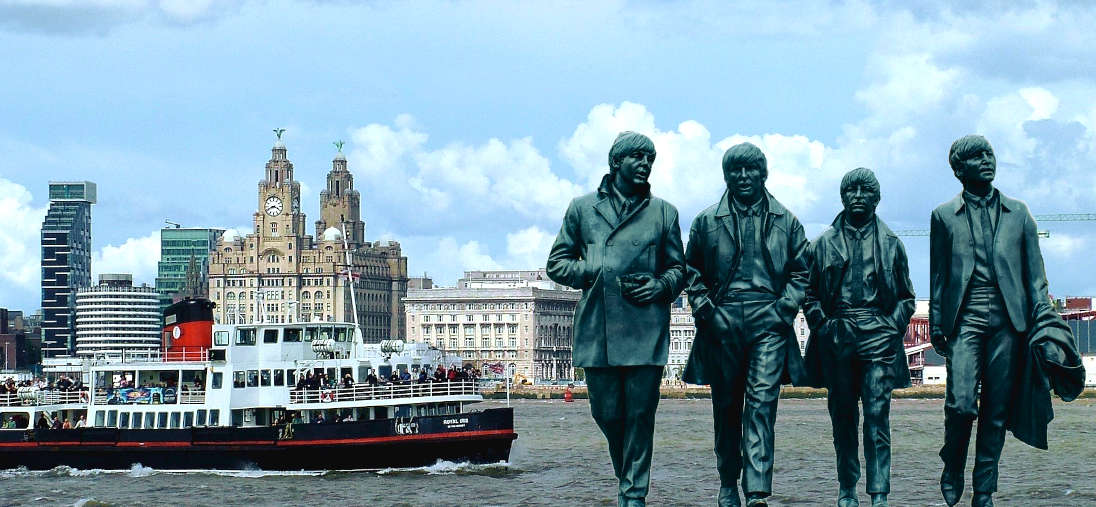
Liverpool, Britain's music city
The city where pop music was born
Elementary / preliminary level English
Liverpool - Music city UK
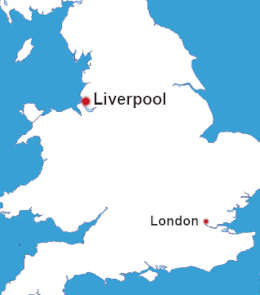
Liverpool is a big city in the north-west of England. It is known for its friendly people, football teams, and beautiful waterfront. But most of all, Liverpool is famous for music. It's often called “the home of pop music.”
 The
most famous group from Liverpool was the Beatles.
They
started to play in the 1960s and became the most popular band in the
world. The four Beatles were John Lennon, Paul McCartney, George
Harrison, and Ringo Starr. They played in clubs in Liverpool before
they became famous.
The
most famous group from Liverpool was the Beatles.
They
started to play in the 1960s and became the most popular band in the
world. The four Beatles were John Lennon, Paul McCartney, George
Harrison, and Ringo Starr. They played in clubs in Liverpool before
they became famous.
In the 1960s Liverpool was still an important port, and lots of ships traded with the USA. Sailors brought records with them across the Atlantic, with new styles of music from the USA. Rock 'n' roll, blues and soul. Bands like the Beatles helped introduce this new music to Britain, and to Europe.
Visitors can learn about The Beatles at the Beatles Story, a museum in the city. The museum has photos, instruments, and all of the Beatles' songs. The Beatles sang about Liverpool, and many tourists visit the city just to see places connected with the Beatles. Some of these places are Penny Lane, Strawberry Fields, and the Cavern Club, where the boys often played.
But Liverpool is not just about The Beatles. The city has a strong music history. Many other pop and rock bands also come from Liverpool, like Echo & the Bunnymen, or the Wombats. Stars from Liverpool have had over 50 number one hits in the British charts, more than any other city in the UK.
Liverpool is also known for live music. There are many places where you can hear music, such as the Echo Arena, Liverpool Philharmonic Hall (for classical music), and many pubs and bars.
Musicians come from all over the world, to play in Liverpool, and there are music festivals in Liverpool every year. The most popular of these is the Liverpool International Music Festival (LIMF). It brings together musicians from around the world. It is famous for presenting new bands, the stars of tomorrow.
In 2008, Liverpool was named European Capital of Culture, and music was a big part of that. The city continues to support music education, with schools and colleges helping young people learn to sing, play instruments, and write songs. Students can even take a degree in Popular Music at the University of Liverpool, or at LIPA, the Liverpool Institute for Performing Arts; a quarter of LIPA's students come from other countries.
In short, Liverpool is a city full of music. Whether you love old songs or new sounds, Liverpool has something for every music fan. It is the home of pop music... and a lot more too.
Discover grammar in a new light
"A breath of fresh air" - IATEFL Voices
Print & ebook from Amazon,
Print book from Barnes & Noble, Waterstones & other good bookshops
waterfront: quay, part of the city which is beside the water - famous: celebrated, well-known - to trade with: to transport goods to and from - sailors: seamen, men who work on ships - records: discs, gramophone records - introduce: import, bring in - connected with: linked to, relating to - charts: hit parade, the top fifty, the most popular music of the week - support: help, provide money for - degree: diploma from a university, BA.
Copyright notice.
This resource is © copyright Linguapress
This text may not be reproduced on other websites nor in printed form without written permission from the publishers. Reproduction is authorised exclusively for personal use by students, or for use by teachers with their classes.
Student worksheet
Exercise 1: Sentence Building
Put the words in the correct order to make sentences. Try to do this without looking back at the original text
→
1960s / in / started / the / Beatles / playing / the / music
→
bands / Liverpool / from / come / many / also / famous / other / pop
→
come / the / in / from / world / all / play / over / Liverpool / to / musicians
→
music / most / is / the / popular / the / city’s / LIMF / festival
→
Exercise 2 Grammar and meaning
Interactive multiple choice exercise. Choose the best option to complete each sentence.
2. The Beatles started playing music before they famous.
3. You can hear live music in many places, pubs and bars.
4. A quarter of the students at LIPA from other countries.
5. The city continues to support music education, and students how to play instruments.
Grammar:
The text repeatedly uses the passive voice to describe Liverpool's reputation, naming, and global status. It is a real-world example of using the passive when the object receiving the action is more important than who is doing it.
About Linguapress. Founded as a print media publisher in 1980, Linguapress is today dedicated to providing free high-quality EFL / ESL resources online for all, anywhere in the world. You are free to use our online resources, within the limits of our copyright policy (basically, don't copy our resources onto any other publicly-accessible platform or website). To help keep these resources free for anyone to use, you can support linguapress.com by sharing with friends and colleagues, or liking us on social media, or buying our acclaimed books for yourself or your school.
© linguapress.com
 Copyright
information.
Copyright
information.