
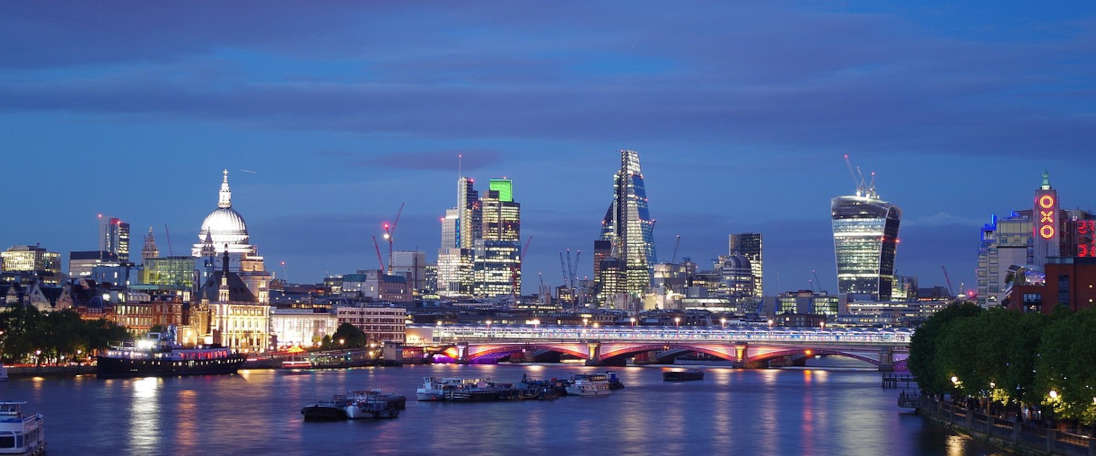
London, historic and modern
Britain's capital city has a long history
Elementary / preliminary level English
London - the big city
London, the capital of the United Kingdom, is one of the oldest and most important cities in Europe. Today, over 9 million people live there. People from all over the world come to learn about its history, to see its famous sitesplace, building, to work, and to enjoylike some time in the city.
Two thousand years of history
London is almost 2,000 years old. The first city was built in the year 43 AD by the Romans, who called it Londinium. It was beside the River Thames, which was important for travelvoyage, going from place to place and tradecommerce.
In the year 1066, William the Conqueror became king of England. He built the Tower of London, which is still standing today.
In the 1600s, London had two big problems. In 1665, the Great Plaguemalady, illness killed thousands of people. One year later, in 1666, the Great Fire of London burned a large part of the city. After the fire, people rebuilt London with better houses and streets, and the city began to expandget bigger, grow.
During the 1800s, London grew even faster. It was the heartcentre of the British Empire, and it became the biggest city in the world.
The modern city
Today, London is a busyactive, lively and modern city, with a lot of historic monuments. Historic places like Buckingham Palace, Big Ben, and Westminster Abbey are very popular with visitors. The city also has very modern buildings like the Shard and the Lloyds Building.
The historic "City of London" is now just a small part in the middle of the modern city. Modern London is important for many reasonscause. It is a centre for business, culture, education, sport and governmentcentral administration. The British Parliament meets in London, and the King lives there too, most of the time. Curiouslystrangely, there is no big football club called London; but there are famous football clubs in London. Chelsea, Arsenal, and Tottenham Hotspur are just three of them.
Today's London is a very cosmopolitaninternational city. Over 250 languages are spoken there, and you can find food, music, and traditions from all over the world.
Global importance
London is important not only to the UK, but to the world. It is a global city, with big banks, famous universities, and important museums. Events like Wimbledon, London Fashion Week, and the Notting Hill Carnival bring in people from everywhere.
Modern London is a city of the past, the present, and the future. In short, it is one of the most interesting cities in the world.
Discover grammar in a new light
"A breath of fresh air" - IATEFL Voices
Print & ebook from Amazon,
Print book from Barnes & Noble, Waterstones & other good bookshops
► For a longer text about London in B1-B2 level English, see The Story of London.
Copyright notice.
This resource is © copyright Linguapress
This text may not be reproduced on other websites nor in printed form without written permission from the publishers. Reproduction is authorised exclusively for personal use by students, or for use by teachers with their classes.
Student worksheet
Exercise 1. Spelling - find the mistakes
Each sentence below has one or two spelling mistake. There are seven mis-spelt words in all. Find the mis-spelt words, and write them correctly in the box
- London is a very cosmapolitan city.
- The British Parlament meets in London.
- People rebilt the city after the Grate Fire.
- London is a centre for busness, culture, education ... and goverment..
- London is one of the most intresting cities in the world..
Read the article, and decide which of the following statements are true. Write true or false in the box. .
- The Tower of London was built before the Great Fire of London. .
- Today, the City of London is only a small part of modern London . .
- There are no football clubs in London . .
- The British Parliament meets in Westminster Abbey . .
- London became the biggest city in the world during the 1800s . .
- Everyone in London speaks English.
Grammar:
This text is good for showing how adjectives are used in English. The text relies on a mix of attributive adjectives to keep descriptions concise within information-dense sentences, and predicative adjectives placed after the verb 'to be' to make direct, clear statements about London.Adjective usage is wide ranging, covering basic, comparative and superlative examples, as well as adjectives modified by an adverb of degree very. It is important that students understand the difference between superlatives, like most interesting, and adjectives qualfied by an adverb of degree as in very interesting.
About Linguapress. Founded as a print media publisher in 1980, Linguapress is today dedicated to providing free high-quality EFL / ESL resources online for all, anywhere in the world. You are free to use our online resources, within the limits of our copyright policy (basically, don't copy our resources onto any other publicly-accessible platform or website). To help keep these resources free for anyone to use, you can support linguapress.com by sharing with friends and colleagues, or liking us on social media, or buying our acclaimed books for yourself or your school.
© linguapress.com

 Copyright
information.
Copyright
information.