
B1 - Simple technical English
The Car of the Future ?
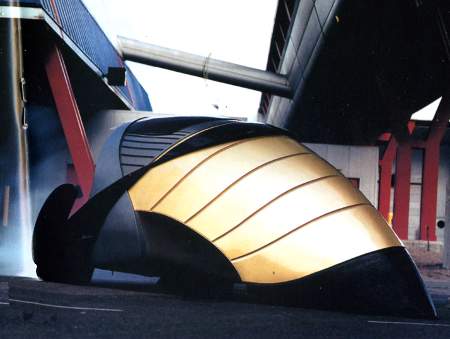 Is this "snail car" what tomorrow's car will look
like ?
Is this "snail car" what tomorrow's car will look
like ?Here is the car of the future! This car is the opposite of
today's cars; today's cars are noisythey make a lot of noise
and dirty, this one is silent and clean. Today's cars have wheels, this
one does not. It moves like a snail ,
but much faster than a snail !
,
but much faster than a snail !
This car will use electric energy, not petrol or gasoleneIn Britain people say petrol, in the USA they say gasolene. It is the same.; it will have batteries that can be recharged instantly from chargers in the road. It will also be very easy to drive.
In fact, you won't need to drive it; it will drive itself. You will just need to tell the computer: "Go to X" and the car will go there. Also, it will reach X very quickly, much faster than today's cars. It will also be very safe and comfortable.
A lot of the technology already exists, but it is very experimental. Already today scientists are developing new materials for the surface of roads: In fifty years from now, perhaps sooner, some new roads will capturecatch, absorb solar energy: they will store this energy under the road, and some cars will be able to use it.
However you probably won't ever drive a "snail car", even if you're under 20 today. This, perhaps, is the car of the year 2100, the car that your grandchildren will maybe drive.
Driving will be nice in the 22nd century ! No pollution, no traffic-jamswhen there are so many cars that they all stop, no stress.
If, of course, we reach the 22nd century....With all today's problems of global warming, pollution, viruses and natural resources, nothing is certain any more. Scientists have lots of ideas about the car of the future: but the future itself is perhaps less sure.....
Return to Linguapress site index
Copyright © Linguapress. Do not copy this document to any other website
Copying permitted for personal study, or by teachers for use with their students
Student Worksheet
The Car of the Future?
Interactive
exercisePut back the twenty missing words in this extract from the article. Some test your vocabulary, others will test your grammar !
Here are the words you will need to use. However take care; this list contains twenty-five words, so there are five words that you will not need to use. You can select a word with your mouse or fingers and slide it into a box.
This car will use electric energy, not petrol or gasolene; it will have batteries that be recharged instantly from chargers in the road. It will also be very drive.
In fact, you won't need to drive it; it will drive . You will just need to the computer: "Go to X" and the car will go . Also, it will reach X very quickly, much than today's cars. It will also be very safe and comfortable.
A lot of the technology exists, but it is very . Already today scientists are developing new materials for the surface of roads: In fifty years now, perhaps sooner, some new roads will capture solar energy : they will store energy under the road, and some cars will be able to use it.
However you probably won't drive a "snail car", if you're under 20 today. This, perhaps, is the car of the year 2100, the car that your grandchildren will drive.
Ideas for teachers
The Car of the Future?
Comparing: Have students take a sheet of paper, and divide it into two columns. In one column, they should write down characteristics of one of today's cars; in the other, comparable features of the "car of tomorrow". Some are mentioned in the text, others can be observed from the photo; still more can be imagined.Explaining: Ask students to describe or define: dirty, silent, a wheel, electric energy, petrol, a battery, a charger, a computer, great-grandchildren, global warming, natural resources, the ozone layer.
All these words, or the concepts they represent, are understandable; defining them is altogether a different task! Some are easy, others not!
Creative writing: Leading to an oral presentation. We are in the year 2100, and the snail car has just been shown to the media. Working in pairs, students should write a short report about the new car. They have one minute (or at most two) on "classroom radio" to present it.
Grammar
Will: This text is an excellent example of the use of will to express future events. Will, of course, is not the only way of expressing the future in English; we can also use forms of going to, and in popular speech these are very common. Also, we use forms of the present tense to express the future (for deatails see Expressing the future ). But in this kind of formal written text, use of will is normally the standard way to express events in the future.... and this text is full of them. Note how in the recorded text, will is often reduced to 'll - even if the word is written in full.Important note: look at the last paragraph.... If, of course, we reach the 22nd century.... In open conditional clauses after if, the verb is always in the present tense, and will is never used. However it may be used in the main clause that normally follows, but which, in this particular case, has come before.... Driving will be nice in the 22nd century
The full sentence could be written: If we reach the 22nd century, driving will be nice.
Other ideas?
EFL teachers: Help develop this resource by contributing extra teaching materials or exercises.
To contribute click here for further details
This teaching resource is © copyright Linguapress
Revised 2021 . Originally published in Freeway, the intermediate level English newsmagazine.
| Linguapress; home | Découvrez l'Angleterre (en français) | Discover Britain |
Other ideas?
EFL teachers: Help develop this resource by contributing extra teaching materials or exercises.
To contribute click here for further details