Intermediate English
WHO IS JAMES BOND ?
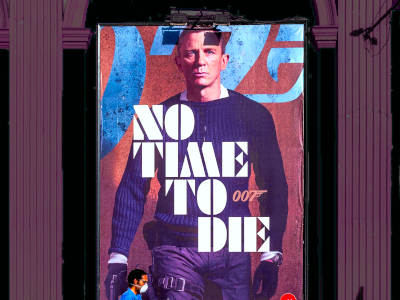 No Time to
Die - which came out in 2021
No Time to
Die - which came out in 2021In one of the first Bond novelsstories, Ian Fleming tells us that James Bond - the classic “Englishman"? - was the son of a Scottish father and an Oriental mother. But perhaps this was not really true.
The title of the 19th Bond film, “The World is Not Enough", was based on the Latin mottoproverb, phrase of the Bond family, which is mentioned in one of the early novels. However, it now appears that the motto is not that of the Scottish Bonds, but that of a different Bond family, who came from the South West of England. So perhaps, Bond really is English, not Scottish, after all. Who knows?
Bond went to school in England, anyway - to Eton College, the same school as his creator Ian Fleming. This is where Princes William and Harry were educated, and also many British Prime Ministers, including David Cameron and Boris Johnson! It is a school where young people learn how to move in high society, as Bond does so well.
After leaving school, Bond did not go to university - it wasn’t necessary in the 1950’s......
Oh? You didn’t know Bond was so old? He doesn’t look it, grantedthat is true, but he is! Like a few other famous people, he seems to have found the secret of eternalpermanent middle age (we can’t call it “eternal youth", can we?).
Bond joined the British Secret Service, where he soon got promoted to the top of the spyrarchyan invented word made from spy and hierarchy (hierarchy rhymes with spyrarchy), the “double O" category. From then on he was 007, “licensed to kill", and so began a careerprofessional life which would take him to all the corners of the earth.
In the early days, Bond’s role was quite clear. He was working for the West, and his main enemies were men from the KGB, and other dangerous organisations. Since the end of the Cold War, the role of MI6The British Secret Service has changed, and Bond’s job profilethe work he has to do has changed with it. Now his main enemies are the big bosses of organised crime and international terrorism.
Unlike the Cold War, organised crime is unlikely to come to an end - at least, not in the near future. We can therefore be sure that James Bond, the best-known English fictional hero of the 20th century, has many more exciting adventures ahead ofin front of him.
Hollywood has already begun making sure of that! The original films were based on the fifteen novels written by Ian Fleming; but after the last of these was made into a film, it was clear that Hollywood was not going to stop! Bond films are too popular and too profitable to abandon. So Hollywood has invented new James Bond stories...
In many ways, Bond has changed a lot since the early days. To start with, several different actors have played the part of Bond, most notably Sean Connery, Roger Moore and more recently Daniel Craig; but over the years, Bond movies have become more and more fantastic. Fleming’s original character was fantastic, because he always came out alive; his adventures were incredible, but they were based on some sort of realism. Bond’s original car (his Aston Martin DB5) had gadgets, but they were all plausiblepossible, realistic! They were gadgets that would let him escape if he was being chased.
More recently, Bond has had cars that can fire missiles from the headlightsmain lights, and do other remarkable things! In a sense, the modern Bond is Agent Gadget - and the people who try to get him have some even more amazing gadgets - like the enormous circular sawa sharp instrument for cutting that hangs under a helicopter, cutting through everything that gets in its way (except Bond, of course!).
In the next Bond films, there will surely be lots more amazing things; but Bond will continue to be the same, cool, calm and collectedsure of himself – the classic Englishman; Craig will not be the last 007, and Bond will doubtless go on entertaining us for many more years!
Read more about James Bond : James Bond, an imaginary interview
Printing: Optimized for printing
Copyright © Linguapress. Do not copy this document to any other website
Copying permitted for personal study, or by teachers for use with their students
Student Worksheet
James Bond
Interactive exercise. Fill in the blanks on screen or on paper : word endings
Replace all the word endings that are missing from the following extract. Try to do this without looking at the original text .Be careful: at least one of the words does not need an ending at all!
(To save your answers, take a screenshot when you have completed the task)
Hollywood has already begun
In many ways, Bond has
Interview with James Bond
Working in pairs, and using information from this article and any other information they may have, students should imagine an interview between a reporter and James Bond. The reporter should ask at least eight questions, including questions starting with:What.... Where..... Why..... How...... When..... How many...... Are you.... Do you...... (the questions can be in any order).
For high-intermediate students:
- Write a summary of this article!
- Comment on the following statement: People should boycott films about James Bond because they are old fashioned and glorify violence!
- Write an e-mail to the casting director and apply for the main role of James Bond or the Bond girl (or, if you are less ambitious, for a smaller part) !
Grammar:
The article uses relative clauses to add historical, biographical, and descriptive information into sentences without breaking the flow.
Non-Defining Relative Clauses
These add extra, non-essential information, separated by commas. They can be removed without making the sentence meaningless
"...the Latin motto of the Bond family, which is mentioned in one of the early novels."
"...a different Bond family, who came from the South West of England."
"...the fifteen novels (-) written by Ian Fleming..." (Reduced relative clause; short for "which were written by")
"...cutting through everything that gets in its way..."
"...the people who try to get him..."
Defining Relative Clauses
These define exactly which person, place, or thing is being talked abou: without them, the sentence becomes ambiguous or meaningless.
"...a career which would take him to all the corners of the earth."
"This is where Princes William and Harry were educated..." (Nominal relative clause of place: where = the place in which )
"...a school where young people learn how to move in high society..."
"...the snow that falls here is usually very dry..."
"...the most famous skiing resorts, which are mostly situated at a height of over 2000 metres."
"...in Colorado and Utah, where the air is usually beautifully clear..."
"...Vail and Aspen, where the stars and the rich go..."
"...gadgets that would let him escape if he was being chased."
"...cars that can fire missiles from the headlights..."
► For more on relatives, see Relative clauses
Other ideas?
EFL teachers: Help develop this resource by contributing extra teaching materials or exercises.
To contribute click here for further details.
| Linguapress; home | Découvrez l'Angleterre (en français) | Discover Britain |