

The Limits to Growth
And what happens if we reach them?
Advanced level English
Words in italics appear in the first exercise below.
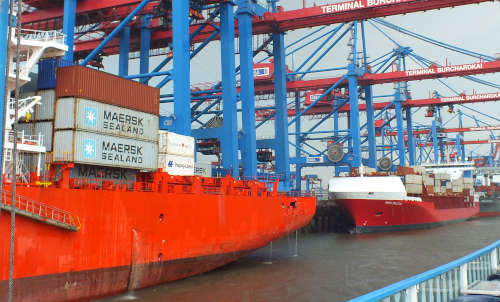
Growth depends on international trade, and vice-versa
Way back in 1972, an international team of scientists and economists, known as the Club of Rome, published a visionary book entitled The Limits to Growth. Using computer simulations to model the global economy and environment, they argued that if exponentialgrowing faster and faster trendstendencies, developments in population, industrialization, pollution, food production, and resource depletion continued unchanged, Earth's physical limits would be reached within a century. The most likely outcome, they predicted, was a sudden, uncontrollable decline in both population and industrial capacity.
Yet, "growth" remains the holy grail promoted by politicians and business leaders worldwide, spanningcovering, stretching across the entire political spectrum. A few small voices dare to suggest de-growth or steadystable, constant-state economics, but they remain voices in the wilderness. Mainstream rhetoricway of speaking, talk dictates that gross domestic product (GDP) must perpetually expand to maintain employment and social stability.
However physical growth cannot continue forever; this is not an opinion, it is an immutable fact of science. We inhabit a finitelimited, having an end planet. The biosphere operates on cyclical, self-regulating loopscircles, systems, whereas our economic architecture reliesdepends, counts on on a linear, extractive model: take, make, use, and discard.
Today, we face growth in all directions, often justified as offering what consumers want. While the size of American automobiles has shrunk compared to the 1980s, passenger vehicles across the rest of the world keep getting bigger. Once a genuinely small car, the British "Mini" now has nothing mini about it other than its name; and one thing leads to another. Growth in car size strainsputs pressure on, stresses infrastructure, and in 2026 for example, the English town of Hove reduced a central car park's capacity from 290 to 180 spaces because today's bloated SUVs and crossovers no longer fit standard baysparking spaces.
This trend can be seen across numerous other fields. Take aviation, where low-cost carriers have encouraged frequent flying, causing a massive surge in fuel consumption and atmospheric emissions. Or phones; in our everyday lives, we are bombarded with advertising to buy the latest smartphones, which keep offering more featuresoptions, special functions that - in all honesty - most users can happily do without. People rush to buy the latest model, not because they need it, but because of the kudos attached to owning one. Yet the hyper-complex software, oversized screens, and resource-heavy hardware come at a cost in both economic and environmental terms. On a larger scale, the energy required to power massive data centres, alongside the computational demands of AI and cryptocurrency, devourseats up, consumes quickly a growing share of global electricity. Even our domestic living spaces have expanded; between 1970 and 2015, the size of the average new US house grew from 1,500 to 2,460 square feet, while average occupancynumber of people living inside per house fell. Though this trend recently cooled to around 2,250 square feet, new house size remains far greater than in 1972.
Unchecked growth goes hand in hand with speed. The modern economic model dictates that everything must be fast, faster or fastest. Fast fashion drives garmentsitems of clothing from shop to landfill in weeks; faster food relies on intensive supply chains; and the fastest high-frequency algorithms destabilize stock markets in milliseconds. This culture of speed breeds obsolescencebecoming out of date or useless, treating planetary resources as limitless and the environment as an infinite waste sink.
Nevertheless mentalities are slowly starting to change. The concepts of Slow Travel and Slow Food are prominent examples of a growing counter-cultural movement prioritizing quality and sustainabilityability to last without harming nature over raw speed. Slow Travel encourages tourists to abandon hectic itineraries in favour of trains, and to stay longer in one place to reduce their carbon footprint. Slow Food, which originated in Italy as a protest against a fast-food franchise near Rome's historic Piazza di Spagna, championssupports, defends local biodiversity and traditional cooking. Similarly, digital fatigue has sparked a tech-backlash, as a growing number of consumers exchange bloated smartphones for old-style, minimalist and non-addictive "dumbphones", to reduce electronic waste.
Elsewhere, positive examples show how growth can be halted in favour of new processes using fewer resources. The "circular economy" is transitioning from a theoretical framework into industrial reality. In several European countries, strict legislation has forced a shift toward extended producer responsibility, legally obliging companies to design products for disassembly and recycling.
A prime example of this deliberate shift is Amsterdam, the first city in the world to formally adopt Kate Raworth’s "donutring-shaped cake economics" framework. Instead of chasing endless financial growth, the city uses a visual model shaped like a donut to guide its public policy. The outer ring represents Earth's critical ecological limits, while the inner ring represents people's basic social needs, such as affordable housing, clean energy, and healthcare. By operating entirely within this "doughnut hole," Amsterdam has redesigned its city planning to actively reduce its carbon footprint and raw material use, proving that a local government can successfully prioritize the health of its people and the planet above economic growth.
In conclusion, the core thesismain
idea, theory of The Limits to Growth
remains as urgent today as it was in 1972, if not more so. While
dominant political and financial institutions remain stubbornlyobstinately, refusing to change
wedded to perpetual expansion, it is the physical constraints of our
planet, not the growth dreams of economists, that will ultimately
dictate the terms of our survival. The emergence of slow movements,
circular industrial design, and successful international regulations,
demonstrates that humanity can easily reorient its priorities. The
choice ahead is not between growth and no-growth; it is between an impending chaotic
collapse imposed by the physical limits to growth, or a managed,
deliberate transition towards a balanced, sustainable future.
Bibliographic reference: The
Limits to Growth , Meadows et al. 1972.
Free download of the original text from Archive.org

LINGUAPRESS ADVANCED ENGLISH - STUDENT WORKSHEET
The Limits to Growth - And what happens if we reach them?
Exercise 1. Phrases and meanings:
From the drop-down lists, select the suggested meaning that most closely corresponds to each of the following words or phrases :
- outcome:
- holy grail:
- voices in the wilderness:
- gross domestic product:
- immutable:
- shrunk:
- bloated:
- surge:
- kudos:
- stock markets:
- waste sink:
- impending:
2. Memory test - nouns
Here is an extract from the document, from which many of the nouns have been omitted. Try to remember which noun was actually used in the text, from the dropdown list of options :3. Reading Comprehension (True / False / Not Given):
Read the statements below and select whether they are True (matches the text), False (contradicts the text), or Not Given (the text does not say).- 1. The Club of Rome predicted that a drop in global population would begin as from 1972.
- 2. Most political and business leaders worldwide aggressively advocate for the reduction of economic growth.
- 3. Unlike passenger vehicles elsewhere in the world, American automobiles have become smaller than they were in the 1980s.
- 4. Local authorities in Hove plan to eliminate all central car parks by 2030 to reduce urban carbon emissions.
- 5. Consumers frequently purchase new smartphone models on account of the social prestige associated with them.
- 6. Low-cost airlines have grown faster in Europe than in other parts of the world.
- 7. The Slow Food movement was founded as a direct protest against a fast-food franchise in a historic part of Rome.
- 8. Amsterdam uses a simple visual plan to make sure people's basic needs are met without harming the environment.
For teachers
Grammar -
This C1 level text well illustrates classic features of semi-formal writing. (► For more on formal writing, see styles of English )1 Noun formation
This text contains a large number of nouns, and notably verbal nouns - nouns formed on the base of a verb. Growth is the first example...growing faster and fastertendencies, developments. but the richest group is made up of nouns ending in -ion. In particular, look at the first paragraph, with its succession of verbal nouns:
2. Compound nouns
These are a standard feature of technical language.
Here are a dozen examples from the text: computer simulations, resource depletion, food production, business leaders, car park, fuel consumption, data centres, landfill, supply chains, carbon footprint, tech-backlash, frameworks.
Note that in most cases, no hyphen is used, while in some cases two words are written as one.... landfill, footprint, frameworks, healthcare, donut (doughnut), etc. For more about this see hyphens.
Ask students to explain what each compound noun means - which involves looking at how the words are related to each other. Note for example how the examples resource depletion, food production are verbal compounds, where the first word is the direct object of the verbal noun that follows.
3 Participle clauses
Here is the list of all participle clauses in the text, categorized by their structural function.
1. Adverbial present participle clauses
These function like adverbial clauses, providing background information, reasons, or showing the simultaneous results of the main action.
...treating planetary resources as limitless and the environment as an infinite waste sink.
...prioritizing quality and sustainability over raw speed.
2. Adjectival (reduced relative) participle clauses
These function like relative clauses (without who/which/that), post-modifying nouns to add descriptive density to a single sentence.
Present participles (-ing) acting adjectivally
...offering what consumers want.
...causing a massive surge in fuel consumption and atmospheric emissions.
...offering more features that... most users can happily do without.
...treating planetary resources as limitless...
...legally obliging companies to design products for disassembly and recycling.
Past participles (-ed) acting adjectivally (passive)
...promoted by politicians and business leaders worldwide..
...justified as offering what consumers want.
...attached to owning one.
...required to power massive data centres...
...shaped like a donut...
...imposed by the physical limits to growth...
Exercise 3: true / false 8/ not given. If you take this as a class exercise, ask students to justify their choices.


 Copyright
information.
Copyright
information.