
Advanced level English
On the night of December 16, 1773, before the United States even existed, men disguised as native Americans threw 342 boxes of British tea into the cold waters the harbor at Boston, Massachussetts. The event, quickly nicknamed the Boston Tea Party, was a dramatic protest against unfair taxes that Britain was imposing on its North American colonies. It sent a clear message... Americans did not want to be ruled by a King and a Parliament in which they were not represented. The King in question, King George III of England, sent troops to put down the rebellion of the American colonies, but to no avail . Less than three years later, on 4th July 1776, leaders of the North American colonies signed their Declaration of Independence, rejecting the authority of the King, and creating a new independent nation, to be known as the United States of America.
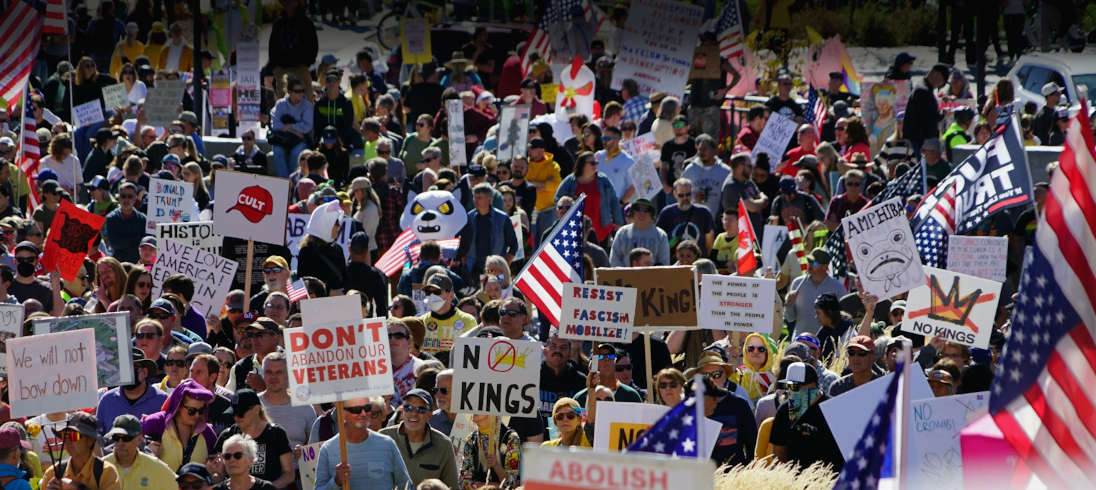
Fast forward more than two centuries, and the spirit of the Boston Tea Party is alive again in the "No Kings" Movement. This modern-day protest movement, which started up in the early 21st century, is a reaction not only to current political tendencies, fashions, but also to the growing influence of relating to companies, businesses power and the unequal distribution of wealth . People involved in the No Kings Movement reject the idea that small, elite groups should have control over the lives of ordinary citizens, in the way that the British monarchy once controlled the North American colonists. According to CBS News, over eight million people turned out on March 28th 2026, in over 3000 marches and demonstrations throughout the USA.... the biggest act of protest in American history.
Historic tradition
To understand the No Kings Movement fully, it's important to look at its roots in American history. In 1773, colonists believed in the idea that "no taxation without representation" was a basic right, and they were willing to take drastic actions to defend that belief.
This wish for independence continued to shape American history long after the Revolution. Throughout the 19th and 20th centuries, Americans repeatedly fought against various forms of oppression. One of the most significant struggles was the Civil Rights Movement in the 1960s, when Black Americans, led by figures like Martin Luther King Jr., fought to put an end to the racial segregation and discrimination which was rife in the USA at the time, particularly in the south. Like the Boston Tea Party, the movement was a success, and in June 1963, president John F. Kennedy proposed the Civil Rights bill, which passed into law a year later.
Shortly after that, millions of Americans, particularly the younger generations, turned out to protest against the Vietnam war. New mass media gave worldwide coverage of the events, which were headed by icons from the worlds of screen and music, notably Bob Dylan, Joan Baez and Jane Fonda. The war was not popular with ordinary Americans, and in the end the protests helped bring it to an end.
The Rise of the No Kings Movement
In recent years, the No Kings Movement has become more visible, particularly in response to the growing influence of corporations in politics. Although there are strict laws in the USA to limit how much individuals and corporations can donate directly to political parties, there are no limits on how much corporations can donate to Super PACs (Political Action Committees). These can acquire, obtain and spend unlimited amounts of money to support specific candidates or campaigns, making a mockery of caps on donations to parties. Many Americans fear that the growing role of big business in the electoral process is eroding democracy, making political leaders more answering to, in the hands of wealthy people who give, donate, money and corporations, than to their constituents .
One major event that brought attention to the No Kings Movement was the Occupy Wall Street protest in 2011. This was a direct response to the growing gap between the rich and the poor, and the perceived corruption of the American political system. Protesters gathered in New York City and other locations across the country, calling for an end to corporate influence in politics; the slogan "We are the 99%" became a to rally means bring together cry for those who felt they were being left behind by a system that favors the wealthiest 1%.
While the Occupy Movement was not explicitly part of the No Kings Movement, the two have in common many similarities. Both advocate for a system in which ordinary people have more say in how society is governed. And both reject the idea that a few wealthy individuals, and even the President, should have so much control over the lives of millions of people.
A Modern-Day Revolution?
The No Kings Movement shares the rebellious spirit of the American Revolution, fighting for freedom, equality, and a voice in shaping society. It continues the fight against inequality and perceptions of abuse of power, reminding us that as long as power is concentrated in the hands of a few, there will always be those who resist and declare, "No kings, no rulers. We are all equal."
This movement is not just about rejecting today’s powerful figures; it’s about creating a new vision of democracy where people are ruled by justice and fairness, not wealth or influence. It is also a peace movement, carrying forward the ideals of past struggles. Like the American Revolution and the Civil Rights Movement, it reminds us that the fight for freedom and democracy is ongoing and must be carried on by each generation.
WORDS:chests: boxes - corporate power: the power of companies - accountable: anwerable to, in the hand of - donors: people who give money, sponsors - locations: places - rallying: to rally means to bring together - share: have in common - Printing: Optimized for printing.
Copyright © Linguapress 2026. Do not copy this document to any other website
Copying permitted for personal study, or by teachers for use with their students
LINGUAPRESS ADVANCED ENGLISH - INTERACTIVE WORKSHEET
No Kings in the USA
Exercise 1: Matching Information
The text has four sections. Which section contains the following information? Write the correct letter (A-D) next to each statement.* A: The introductory paragraphs
* B: Historic tradition
* C: The Rise of the No Kings Movement
* D: A Modern-Day Revolution?
1. A comparison between corporate donors and historical monarchs.
2. The specific date and scale of the largest protest in American history.
3. The role of 20th-century cultural icons in anti-war efforts.
4. A definition of Super PACs and their impact on political caps.
5. The ultimate goal of the movement regarding the concentration of power.
Exercise 2: Interactive: Multiple
choice comprehension questions :
Reading skills - Read the text carefully, then decide which answer is correct for each of the following questions.
B) Americans rejected being governed without representation.
C) The harbor at Boston was too cold for British ships.
D) Native Americans were responsible for the rebellion.
B) CBS News was banned from covering protests.
C) Over eight million people participated in nationwide demonstrations.
D) The King of England visited the United States.
B) As a revival of the authority once held by the British monarchy.
C) As a more efficient way to manage ordinary citizens.
D) As a group that should be given more direct political power.
B) It was primarily a protest against the Vietnam War.
C) It resulted in the passage of a significant bill into law in 1964.
D) It was led by icons from the world of music like Bob Dylan.
B) It was ignored by the global media.
C) It was the only movement that failed to achieve its goals.
D) It received global attention through new mass media channels.
B) The way unlimited corporate spending bypasses limits on direct party donations.
C) The total ban on all political donations in the USA.
D) The legal requirement for corporations to support specific candidates.
B) The Civil Rights icons of the past.
C) Wealthy donors and large businesses.
D) The spirit of the 1776 Revolution.
B) The gap between the wealthy 1% and the rest of the population.
C) A demand for the return of the British monarchy.
D) The promotion of the Vietnam War.
B) A movement focused solely on rejecting individual leaders.
C) A peace movement seeking a vision of democracy based on fairness.
D) A short-term reaction that will not last for future generations.
B) It ended successfully with the signing of the Declaration of Independence.
C) It is a lost cause due to the power of modern corporations.
D) It is only relevant to those living in the Southern United States.
Exercise 3: Sentence Completion
Instructions: Complete the sentences below. Choose NO MORE THAN THREE WORDS from the text for each answer.B. Leaders of the colonies officially broke away from the King by signing the in 1776.
C. The Civil Rights Movement sought to eliminate which was especially prevalent in the American South.
D. Unlike direct donations to parties, there are on the amount of money corporations can give to Super PACs.
E. The famous phrase "we are " was used during the Occupy Wall Street protests to represent the majority of citizens.
For teachers
Grammar: negationNote the title of this text "No Kings". When nouns are put in the negative, we use the word no, rather than not, which is used with verbs. For more on this see Negatives in English grammar.
News and culture
This text is particularly relevent to events in the USA since 2024. However it relates these events to some of the major events and movements in United States history, events that help us to understand not just today's America, but the way the USA has developed over time.
Using the text in class
Fourteen words in the text are followed by a dropdown choice of alternatives. In each case, only one answer is logical. Use the button to show or hide the MCQ options; this is a particularly useful option if you are presenting the page on an interactive whiteboard.
Answers
Ex 2: 1. B | 2. C | 3. B | 4. C | 5. D | 6. B | 7. C | 8. B | 9. C | 10. A
Ex 3: 1. unfair taxes | 2. Declaration (of) Independence | 3. racial segregation | 4. no limits | 5. the 99%

 Copyright
information.
Copyright
information.