
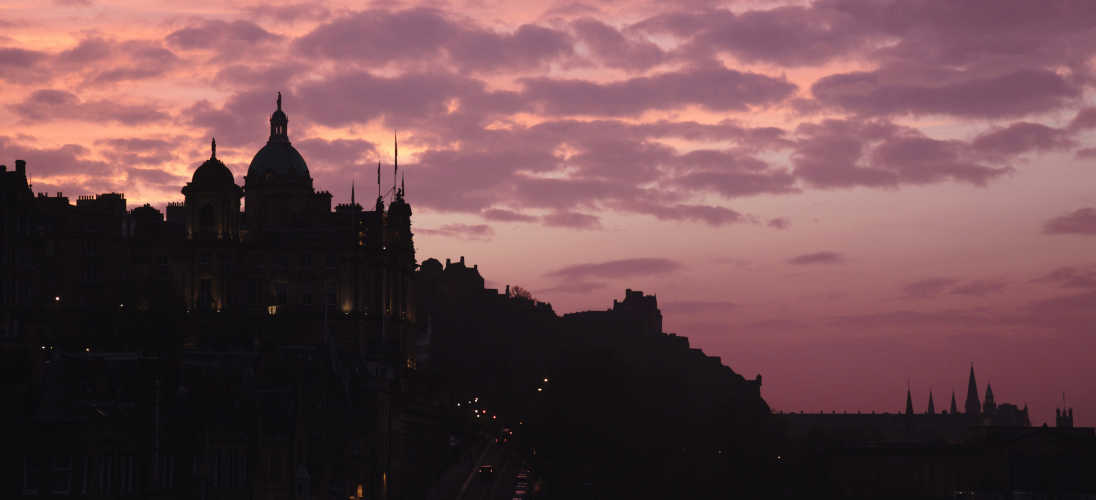
Edinburgh, world capital of culture
Scotland's capital is like no other city
Elementary / preliminary level English
Edinburgh - old and new
Edinburgh is one of the historic capitals of Europe, like Paris, Rome, Vienna or Athens. The capital city of Scotland is known for its culture, its wonderful viewspanoramas, and rich history. With its many historic monuments and its cultural traditions, it is sometimes called "the Athens of the North"
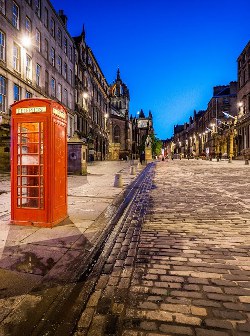
Today, Edinburgh is a big modern city, with half a million inhabitantsresidents, people; but in the middle of the modern city there are two historic cities, called the Old Town, and the New Town.
Edinburgh's "Old Town" is one of the finest old cities in Europe; it is also one of the most distinctiveunique, characteristic, because it sits on a ridgelong narrow hill between a castle and a palace. Edinburgh Castle is a large historic fort, built on top of a rock. Today, it is still a military castle, but also a museum that tourists love to visit. At the bottom end of the old town is the Palace of Holyrood, which is still a royal residencehome, living place.
The castle and palace are joined by a famous old street, called the Royal Mile. Beside it there's a cathedral, some official buildings, parts of the University, and lots of shops.
To the north of the old city, there was once a lake. Today there is a railway line and the city's main railway station, as well as some famous gardens, and art galleriesart museums. Beyond them, parallel tolying alongside the old town, stands the "New Town", which is a UNESCO World Heritagehistoric Site. The New Town is no longer new, but it is newer than the "old" town. It was begun in the 18th century, and is a beautiful old city, in the neoclassical style, like Washington or Saint Petersburg. At the southern edge of the New Town is Princes Street, Edinburgh's other famous street. Princes Street is one of the most famous shopping streets in Britain... and the most attractive.
Discover grammar in a new light
"A breath of fresh air" - IATEFL Voices
Print & ebook from Amazon,
Print book from Barnes & Noble, Waterstones & other good bookshops
Education and learning are also a big part of the Edinburgh story. The University of Edinburgh opened in 1583 and is one of the oldest and best universities in the world. Famous thinkers, scientists, and writers have studied here over the years, making the city an important centre for thinkers and writers. Walter Scott, Robert Louis Stevenson, or J.K.Rowling are among well-known writers who have lived in Edinburgh.
And as for culture...
Today, Edinburgh is known as a world capital of culture. Every summer, millions of visitors come to the city for the famous Edinburgh Festival. The official festival is big.... with about 150 events! But the festival's "Fringeunofficial, alternative festival" is far bigger, and is the largest arts festival in the world. Performersactors, musicians, entertainers, actors, and comedians come from all over the world. They put on thousands of shows in theatres, halls, and even on the streets.... and at all times of the day and night! Nobody can possibly see everything on the "Edinburgh Fringe"..... In 2026, there were over 3,500 different shows to see ... in three weeks.
Finally, Edinburgh is the capital of Scotland, and the seatbase, headquarters of its government. For now, Scotland is part of the United Kingdom, but it is governed by the Scottish Nationalists. They hope that Scotland will soon become independent, and Edinburgh will then become the capital of a sovereignindependent, self-governing state..... not just a part of the United Kingdom.
Copyright notice.
This resource is © copyright Linguapress
This text may not be reproduced on other websites nor in printed form without written permission from the publishers. Reproduction is authorised exclusively for personal use by students, or for use by teachers with their classes.
Student worksheet
Exercises:
Exercise 1: Identifying Information (True / False)
Read the statements below and write TRUE if the statement agrees with the text, or FALSE if the statement contradicts the text or is not given).
1. Edinburgh Castle is built on top of a rock and serves both as a military castle and a museum.
2. The New Town of Edinburgh was built in the modern architectural style.
3. The New Town lies to the south of the railway line.
4. The Edinburgh Fringe is the largest arts festival in the world.
5. Scotland is currently an independent, sovereign state with its capital in Edinburgh.
Exercise 2: Sentence Completion
Complete the sentences below. Choose between one and three words from the text for each answer.
1. The street connecting Edinburgh castle and Holyrood palace is known as
2. The Old Town and the New Town lie at the heart of the
3. The New Town is recognized by UNESCO as a
4. The famous University of Edinburgh was established in the year
5. During the Edinburgh Festival, thousands of performers, actors, and comedians put on shows in theatres, halls, and
Exercise 3: Vocabulary Matching
Match the words from the text (1-5) with their correct definitions (A-E).
| Word 1. Panorama 2. Resident 3. Residence 4. Founded 5. Sovereign |
Definition A. Independent and self-governing. B. A broad, wide view of a surrounding area. C. Created or started . D. A person who lives or resides in a particular place. E. A house, living place, or home (especially an official one). |
For teachers
The audio recording:
Scottish English : the audio recording for this text is an introduction to a Scottish accent. The speaker has a slight Scottish accent which even elementary level learners should be able to understand. The main difference that you will maybe notice, is that in Scottish accents in general, the definite article the is pronounced [ðə] (with a schwa sound) at all times, even before words beginning with a vowel.Note that there a three or four differences between the written and audio versions of the text: this is deliberate, to let students passively absorb some synonyms.
Grammar:
Use of adjectives : use this text to illustrate different ways in which adjectives are used in English.Predicative adjectives: is a big modern city, is no longer new, is newer, is far bigger.
Comparative Forms: newer, far bigger (with a degree modifier).
Superlative forms: finest, most distinctive, oldest, best, largest, most famous, most attractive.
Proper adjectives: European, Royal, UNESCO, Scottish, United.
► See this grammar page for questions of adjective order.
CEFR level. A2.2 - B1
This text scores on certain level checkers as a "B1" document, notably because it relies on some B1-level structures, such as relative clauses, comparative and superlative adjectives, and the simple passive. However these structures are used in the context of fairly simple sentences, making this text generally accessible to A2.2 level students.It is impossible to write substantive texts adhering strictly to A2 level standards.... which is why the A2.2 grading exists. The A2.2 grading reflects the fact that a lot of supposedly "difficult" vocabulary is not actually difficult at all, notably for learners who are familiar with another European language. Proper nouns, like Athens, and a lot of supposedly diffcult vocabulary, such as station, royal, official, kingdom, etc. present no difficulty for reasonably literate adolescents or adult readers, whatever their native language, since these words are identical or similar or familiar across different languages. Such words need no explaining, and do not appear in the vocabulary guides. Other less familiar words are explained.
As for structures, B1-level structures are used in fairly self-explanatory contexts, so will not need explaining for most students.
To progress well in English, learners need to face some reasonably challenging tasks. For elementary A2-level students, A2.2 graded texts do just this. It is up to the teacher to explain points that are not understood - which will depend completely on the nature and native language of students in a given class.
About Linguapress. Founded as a print media publisher in 1980, Linguapress is today dedicated to providing free high-quality EFL / ESL resources online for all, anywhere in the world. You are free to use our online resources, within the limits of our copyright policy (basically, don't copy our resources onto any other publicly-accessible platform or website). To help keep these resources free for anyone to use, you can support linguapress.com by sharing with friends and colleagues, or liking us on social media, or buying our acclaimed books for yourself or your school.
© linguapress.com
 Copyright
information.
Copyright
information.