
The death of Charlie Huff
A B1 intermediate English short story from Ireland
By Brian Sheehan
☘ Words in purple that turn green ☘ click for instant vocabulary explanation
The night before, we drove down in my brother’s old Toyota. The heater was broken, so in November, the windscreen became hard to see through . My brother watched for cars. I watched for signposts.
The ceremony for a person who has died was on Thursday. I wore a dark blue jumper and my good coat. My mother said the Huff men bought new black suits, though they looked shiny and cheap. She had brought them ham sandwiches and a basket of fruit. They ate the sandwiches.
Charlie Huff, who had died aged seventy, did not eat sandwiches. He ate two big dinners a day: meat, potatoes, and onion sauce, along with whole packets of biscuits. He drank a kind of energy drink and Guinness. He ate fruit once a year at the Strawberry Fair in Stradbally. When my brother and I were kids, we sometimes stayed over in the Huff house, and we ate mini pizzas and chips. At home, we asked our mother why we couldn’t have chips for tea. She said we had home‑cut chips on Saturdays. I said it was unjust and that we should eat like the Huffs
I sat in the back, my mother in front and my brother drove. The river had burst its banks and covered in water Charlie’s fields. I remembered the welcome sign we had once made for our small rural area in Ireland; a bridge, rushing water and a a kind of fish. Charlie Huff pulled it up and threw it in the river. I was twelve at the time; my brother ten. My brother told him we were joking. Charlie stared at us.
“We were messing,”
I said.
He kept staring. “There’ll be no messing around here.”
Charlie had a crest on his lorry; a hunting dog on a red field. In school, Gemma Huff said it was the Huff crest. The teacher showed her a different one in a book; three lions on dark orange. She said it was the crest of the O’Heachach family, the Gaelic name for Huff. The next wet morning, Charlie parked his lorry across the school gates. The teachers had to park on the road.
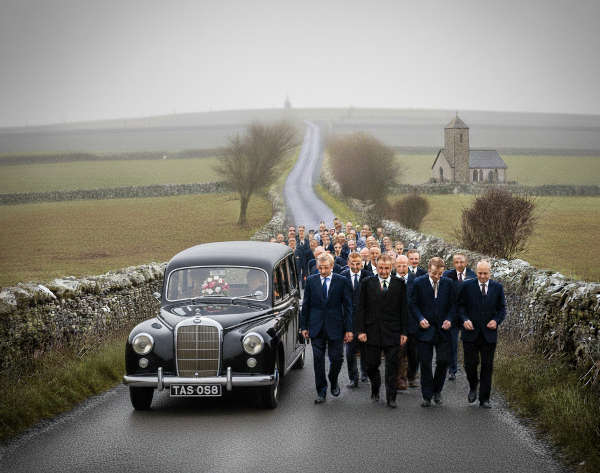
We arrived at the house as the men carried the coffin to the hearse.
I said, “Irish expression of condolences” to the family. I felt embarrassed. I not any more knew them.
We followed the cars to the church.
At the end, Charlie lay in a bed by the cooking stove, yellow‑skinned, staring at the ceiling. Before he passed, his sister, Margaret, visited him from Boston.
“Cha,” she said, holding his hand. “Cha.”
This was all she could say. He said nothing.
As we followed the hearse over the bumpy roads, my mother began to cry.
“What’s wrong?” I asked.
“He was such a good-looking man,” she said.
“So?”
“So, he got old... I remember when they built the house. We were the only two houses on the lane. You and the Huff girls picked berries. You were so small.”
She covered her face.
“Your grandfather came home this way,” she said.
She meant after he died in the retirement home for old people, twenty years ago. There was a flood then too.
“Sorry,” I said.
I had not expected this. I felt sad for her, for everyone.
We parked beside the village technical school. My brother and I had attended there. Our uncles too. The school was open seventy‑five years. Charlie had attended for three. A row of boys sat on the wall in front. deep red jumpers stretched at their wide shoulders. It surprised me that the school was open. The bank was open too. But the world did not stop for the death of Charlie Huff.
In church, our neighbours sat at the front. My father sang with the group of singers. Father Conor said Charlie was known as “Cha”. He said Cha was loved and respected. That he liked tractors and cows. That he enjoyed a few glasses of beer and fun. I could not remember the fun. There was a crowd because the family was big and kind. Charlie was a hard man. But here he sounded like a rogue. Maybe he was. I don’t know.
The Huff women followed the hearse in the funeral organiser car. The men walked behind, down the road then up the long hill to the graveyard. Mist turned to very fine rain. The family had no umbrellas.
At the place of burial, Father Conor rushed the benediction. Suit trousers got wet. Rainwater filled shoes and socks. Trucks rattled past and it was difficult to hear. People were unsure if they should go to the hotel for sandwiches. In the car park, my brother swerved to avoid a dog and broke the headlight of a white Range Rover.
As the last of the mourners left the graveside, the dog got in. He jumped up on a woman in high heeled shoes. The woman slipped in the mud and hurt her foot. Shocked, she was silent for a moment, then cried. The sky opened and I looked to the heavens. For the last time, maybe the first, I felt Charlie Huff smile.

Return to Linguapress site index
Printing: Optimized for printing
Copyright © Brian Sheehan and Linguapress. Do not copy this document to any other website
Copying permitted for personal study, or by teachers for use with their students
Interactive student Worksheet
- Charlie Huff was carried to his funeral in an old Toyota.
- When he was a child, the narrator liked to eat chips.
- Charlie Huff liked eating fruit and vegetables.
- As a child, the narrator thought the Huff family’s meals were better than their own. .
- Charlie Huff was very well educated.
- Charlie Huff used to live alone by himself.
- The narrator’s brother accidentally damaged someone’s car in the car park.
Exercise - comparisons
List A contains the six words which are in maroon in the text; list b contains six definitions. Match the definitions to the words, putting the correct number in the box after each word.
| List a) | List b) |
| Mourners | 1. A vehicle used for carrying a coffin |
| Hearse | 2. A person who is dishonest or behaves badly, but is often liked anyway. |
| Crest | 3. People who attend a funeral to show sadness for someone who died. |
| Rogue | 4. A family symbol or design, often found on old buildings or uniforms. |
| Messing | 5. To turn or change direction suddenly (usually while driving) |
| Swerve | 6. Joking or behaving in a silly or annoying way (informal). |
2. Word search: read through the text and find:
- Five words that express family relationships.
- Four words describing a type of vehicle
- Five types of building
- Six colours.
3. Memory test - verbs
Here is an extract from the story, from which some of the verbal expressions have been omitted. Try to remember how the verb was used in the story, from the dropdown list of options :I in the back, my mother in front and my brother . The river burst its banks and flooded Charlie’s fields. I remembered the welcome sign we had once made for our townland; a bridge, rushing water and a trout. Charlie Huff pulled it up and it in the river. I was twelve at the time; my brother ten. My brother him we were joking..
Notes for teachers
There is a lot of vocabulary in this story, that your pupils will probably not know. Most of it is explained in the vocabulary guide, and many of the words are not everyday words that need to be learned; when taking this story in class, do not concentrate on specific vocabulary, concentrate on the story, and the way it mixes the past and the present. For each paragraph, it is important that pupils understand whether it refers to the past (the author's memories of Charlie Huff) or to the present (events on the day of the funeral).Other ideas?
EFL teachers: Help develop this resource by contributing extra teaching materials or exercises.
To contribute click here for further details
This teaching resource is © copyright Linguapress
Republication on other websites or in print is not authorised
| Linguapress; home | Découvrez l'Angleterre (en français) | Discover Britain |

 From
Amazon
From
Amazon