
A low-intermediate level English resource.
Looking for the Yeti
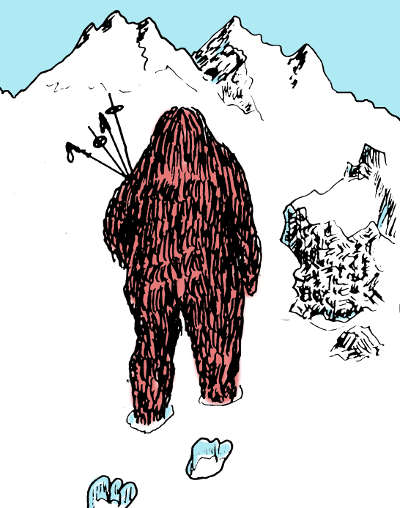
First of all, what is a yeti? Himalayan people say there are two sorts of yeti. Both are big — about two metres high — and both can walk on two legs. One (the smaller yeti) eats humans !!! But the larger yeti likes yaks (similar to big black hairy cows). The yeti doesn’t live in the snow, but in the thick Himalayan forestwoods. It goes up into the snow to eat a plant which contains salt.
That is the legendstory. It is easy to say that the yeti is just a legend. However, people have discovered other evidenceindications.
In 1951, British mountaineerspeople who like climbing mountains found footprintstraces made by feet in the snow on Mount Everest, at a heightaltitude of 6000 metres. These footprints were about 28 cms. long. They showed five toes. The footprints were made by a large creature of at least 100 kilograms. No human or animal has footprints like these.
SO what is a yeti — if it exists? Some people think it is like a «Giganto-Pithecus», an animal that lived in China and India about half a million years ago. Did this animal go and hide in the mountains, when man appearedarrived?
We do not know the answer. Chris Bonnington’s team did not find a yeti; but one man thought he saw one. They also found some large footprints in the snow. Then they found the skins of two sheep. Someone — or something — had killed the sheep, then skinnedtook off the skin them very well, with a toolan instrument (a knife, for example). And one day, the men lost two pairs of ski polessticks, batons. In the evening they put the poles under a rock. Next morning the poles weren't there! So where were they? There were no other people in that part of the mountains. So who had taken the poles? A yeti? Nobody knows!
Is this enough to provesay for certain that the yeti exists?

discover: find out, /earn - legend: story - forest: woods - evidence: indications - mountaineers: people who like climbing mountains - footprints: traces made by feet (see the picture) - height: altitude - appear: arrive - to skin: to take off the skin - a tool: an instrument (a knife, for example) - poles: sticks, batons - prove : say for certain
Return to Linguapress site index
► More legends and mysteries: See the Loch Ness Monster / Robin Hood
Printing: Optimized for printing
Copyright © Linguapress. Do not copy this document to any other website
Copying permitted for personal study, or by teachers for use with their students
Student Worksheet
Example: I‘ve just seen my grandmother. She’s going to climb Mount Everest.
Becomes: I‘ve just seen my grandmother, who's going to climb Mount Everest.
| 1. The
Menhungste is a mountain. 2. Chris went there with 5 other men. 3. The yeti goes to snowy regions to look for a plant. 4. The «Giganto Pithecus» disappeared about half a million years ago. 5. The members of the expedition found two sheep. 6. The expedition also found large footprints. 7 No-one found a yeti, except perhaps one man. 8 «The yeti exists!» say lots of people. |
1.
It is in the
Himalayas. 2. They wanted to find the yeti. 3. It contains salt. 4. At that time, man appeared. 5. They were dead. 6. They were in the snow. 7. He thought he saw a yeti behind him. 8. These people live in the Himalayas. |
Find as many different answers as possible for each of the following situations.
What did the members of the expedition say.......
- - when one member thought he saw a Yeti?
" ____ - - when they found footprints in.the snow?
" ____ - - when they discovered the sheep?
" ____ - ~ when they couldn’t find the ski poles?
" ____
For Teachers
Vocabulary:Can students find words in the text which mean the opposite of
THIN . SHORT . LOW . DIFFICULT?
Can they find a synonym tn the text for BIG?
* Study:
Himalaya — Himalayan
Now ask students to do the same with these words: |
AMERICA . AFRICA . RUSSIA . ASIA . INDIA . CORSICA . AUSTRALIA
Now ask what other countries they know the names of.... and what are people from these countries known as ?
Oral expression:
What did members of the expedition say when.... exercise. When sufficient possibilities have been found, ask students to write a conversation
between the expedition members in one of the four situations suggested.
* Do your students think the Yet! exists? Why, or why not?
This teaching resource is © copyright Linguapress - renewed 2026.
Fully revised and extended 2020 . Originally published in Horizon, the Low-intermediate level English newsmagazine.
Republication on other websites or in print is not authorised
| Linguapress; home | Découvrez l'Angleterre (en français) | Discover Britain |