Linguapress English Grammar
Adjective order in English
Putting adjectives in the right order in English
It's as easy as ABC
 How is it
that native English speakers naturally place adjectives
(and secondary nouns
acting as adjectives) in the "correct" order when writing or speaking ?
Very few native English speakers have ever learnt, or even thought
of, the rules that determine the order in which adjectives are placed.
How is it
that native English speakers naturally place adjectives
(and secondary nouns
acting as adjectives) in the "correct" order when writing or speaking ?
Very few native English speakers have ever learnt, or even thought
of, the rules that determine the order in which adjectives are placed.
This obviously means that the rules are a) very basic and intuitive, and b) very few in number. More than rules, they are principles.
Adjectives are placed in English according to their nature or type. There are three groups of adjectives, defining the qualities of a noun :
► A. Articles
& accessories,
relative or perceived circumstantial qualities.
► C. Classifying adjectives, innate or fundamental permanent qualities
At the
start of group A come Articles
and determiners
► B. Basic, permanent
but circumstantial qualities► C. Classifying adjectives, innate or fundamental permanent qualities
And of course, they will be placed in the natural order ABC, with the most fundamental adjectives coming closest to the noun, i.e. last. Each group contains different types of adjectives, which may (or may not) require a specific sequence.
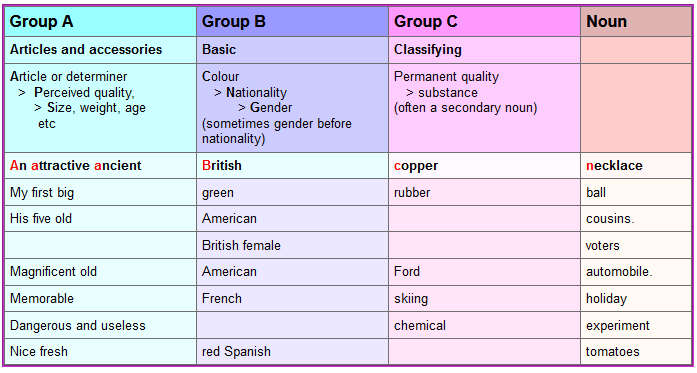
Important ! It is common to find two or three adjectives before a noun, but it is very rare indeed to find more than four adjectives at a time. Memorise the first example which clearly (and literally) illustrates the ABC rule.
When two group A adjectives of similar nature qualify the same noun, they may be linked by and. However and is never required to link adjectives from different groups.
You can learn more about linking two adjectives with the word and in the Descriptive Grammar of English ebook or paperback.
Look at English grammar with Linguapress. Simple rules, clear examples.
 Copyright
information.
Copyright
information.If you like this page and want to share it with others, just share a link, don't copy.