
Living without Energy
Everyone says that we must use less energy ! But how? That is the big question.
In this article, you can read about the house of the future, which uses hardly any energy at all.....
 Most
houses use
energy - lots of it. We use energy for heating, lighting, for running
our household appliances - TV's, washing machines, fridges, and so on.
In winter time, most houses use dozens of kilowatts of electricity
every day, or the equivalent in gas.
Most
houses use
energy - lots of it. We use energy for heating, lighting, for running
our household appliances - TV's, washing machines, fridges, and so on.
In winter time, most houses use dozens of kilowatts of electricity
every day, or the equivalent in gas.
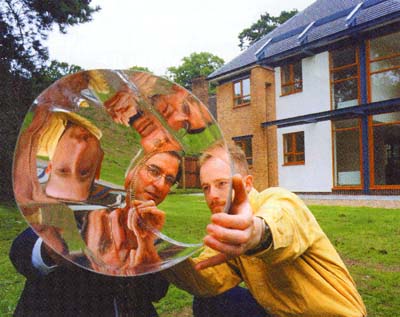
The house in the photo, on the other hand, uses virtually nothing: most of the energy that it uses comes straight from the sun, the wind or the ground. This is an experimental house at the University of Nottingham, and it could be the kind of house that most people are living in fifty years from now.
During the daytime, it is rarely necessary to turn on an electric light, even in rooms without windows. Sunlight, or daylight, is "piped" through the house, into each room, through special high-reflection aluminium tubes. You can see how well they reflect light, by looking at the reflections of the faces in the picture!
At night, of course, energy is necessary - but most of this comes from the sun or the wind. The house is fitted with photovoltaic solar panels that generate electricity during the daytime, and a wind turbine power generator too; electricity from these can be used directly, or else stored in batteries, and used when it is needed.
For heating, the house uses direct solar energy (sunshine heating water that circulates through a radiator system), or geothermal energy. This takes low-level heat out of the ground, and uses a heat-pump to convert it into high-level heat for use in radiators - the same principle as a refrigerator, but in reverse.
As for water, most daily needs are provided for by the house's own supply; rainwater is collected on the roof, filtered, and used for all toilets, baths and showers.
If, one day, most people in developed countries live in houses like this one, most of today's pollution will have disappeared, and global warming may be a problem of the past.
WORDS:
fitted: equipped - generate: make, create - store: conserve, keep - geothermal: from under the ground, from the earth - in reverse: backwards - supply: provision
Copyright © Linguapress. Do not copy this document to any other website
Copying permitted for personal study, or by teachers for use with their students.
Student worksheet
LIVING WITH NO ENERGY
Interactive exerciseTechnical language - article use:
Choose
a suitable article whenever one is necessary - but only if an
article is essential.
If no article is needed or the article can be omitted, choose
-.
During daytime, it is rarely necessary to turn on electric light, even in rooms without windows. sunlight, or daylight, is "piped" through house, into each room, through special high-reflection aluminium tubes. You can see how well they reflect light, by looking at reflections of faces in picture!
At night, of course, energy is necessary - but most of this comes from sun or wind. house is fitted with photovoltaic solar panels that generate electricity during daytime, and wind turbine power generator too; electricity from these can be used directly, or else stored in batteries, and used when it is needed.
For heating, house uses direct solar energy (sunshine heating water that circulates through a radiator system), or geothermal energy. This takes low-level heat out of ground, and uses heat-pump to convert it into high-level heat for use in radiators - same principle as refrigerator, but in reverse.
FOR TEACHERS
Other ideasPay attention to the use of articles in this text. Note how articles are not used with (a) general abstractions (such as energy, sunlight, electricity), nor (b) with generalising plurals (such as through... tubes / solar panels / radiators). On the other hand, they are necessary with defined "count nouns" in the singular or plural (for example The house in the picture.). For more information on this point see Using the Article in English
Above there is a blank fill exercise covering part of the article ; have students insert articles where they are needed.
Important note: there are many cases in English where the article is optional; some nouns or noun groups can be interpreted either as generalisations or as (defined) restrictive uses. In the paragraphs below, the article is thus not essential before rooms, in the phrase in rooms without windows. There are two possible interpretations:
in the (i.e.only certain defined) rooms - those that do not have windows.
The same is also true for how well they reflect light.
Light is either light in general, or else could be
the light (i.e. just the light that comes through the tubes).
We can also justify during daytime or during the daytime (i.e. the defined part of time that is during the day).
These are the only real borderline cases in the text.
Other language point:
Pay attention to the use of prepositions in this article.
This teaching resource is © copyright Linguapress .
Republication on other websites or in print is not authorised
Other ideas?
Help develop this resource by contributing extra teaching materials or exercises.
To contribute click here for further details