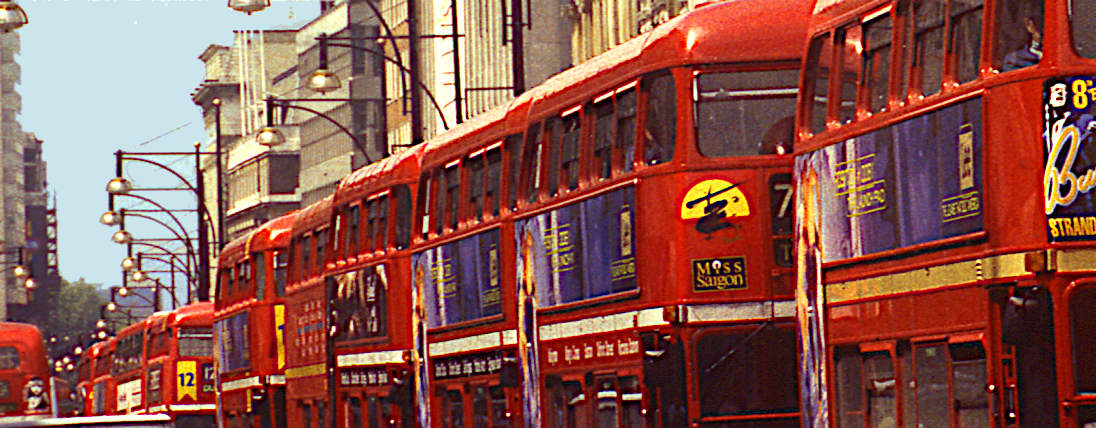
What is the most recognisable symbol of London? Big Ben? The statue of Eros in Picadilly Circus? Or could it be something much less artistic than that? Could it be the big red London double-decker bus?
It certainly could.
Big red buses are recognised all over the world as symbols of London. Visitors climb into London buses to go and see the Niagara Falls. London buses can be seen driving round Europe to advertise big department stores, or British events . They don't need to have the words "London Transport" on the side of them. They are instantly recognised by millions of people !
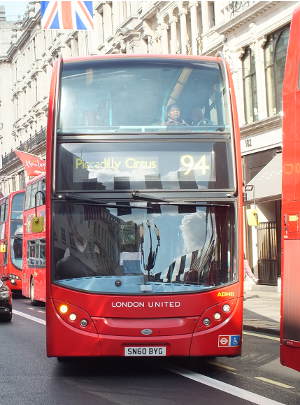 Red London buses in the 2020s
 The idea of the "double decker" is actually much older than the motor bus. It is simply a continuation of the system that was used for public transport in the age of horse-drawn vehicles, when some of the passengers sat inside, and the rest travelled on the roof. Too bad if it was raining!
The earliest double-deckers omnibuses in London were horse-drawn vehicles. Like some of today's double-deckers, they had steps at the back, to let people climb up onto the roof. The main difference was that in those days, there was no protection for the people travelling on top. If it rained, they could pull a sort of oil-cloth cover out of the back of the seat in front of them, and pull it over them; but you still got pretty wet.
It wasn't until the 1930's that all new buses came equipped with roofs over the upper deck! Increasingly powerful engines meant that buses could be bigger and heavier. Like trams, they could then have roofs.
The most famous London buses, however, are not those that filled the Capital's streets in the 1930's, but the powerful "Routemasters" which dated from the 1950's and 60's. These are the buses that have been taken all over the world, the buses that feature in the tourist brochures, and the ones which have been sold, in miniature, to millions of visitors and souvenir hunters.
The Routemaster is an icon in itself! These buses were designed specially for London, by people who knew what London needed, and they served their purpose well, and did so for half a century !
Things started to go wrong for the London bus in the late 1960's. That was when the Ministry of Transport decided that it would only give financial help to bus companies that bought new buses with doors! Suddenly London Transport found they could no longer buy any more of their favourite Routemasters, that they had designed. They had instead to choose other models. They have been buying other models ever since.
(End of audio text)
The end of the story
In the late 20th century, five hundred of the solid and popular old buses were extensively renovated, and put back on the road as good as new, if not better! But not even the Routemaster could resist the winds of change. Modern transport systems require one-man buses, not buses with both a driver and a conductor. So in 2005, the old Routemasters were finally taken out of normal service.
Still, it's not too late to enjoy travelling on one of these historic buses. Some of the old buses have been preserved, and were used for a while on two "heritage routes" through the centre of London, specially for tourists. Route 9 went from the Royal Albert Hall to Aldwych, via Piccadilly circus and Trafalgar Square; but the last Routmasters were used on this route in 2014. In 2020, the only route left was Route 15, which goes from Trafalgar Square to the Tower of London, via St. Paul's Cathedral. But other old Routemasters are used by the tourist bus companies, which offer trips round the centre of London.
Today, every day, thousands of Londoners use the big red buses to move - often slowly - around town. Lots of tourists know that a one-day London bus pass, valid on all regular bus routes, offers a wonderful way to see Britain's capital city.
WORDS: advertise: publicise, promote conductor: on a bus, the man who sells tickets, not the driver. - department stores: big shops with lots of different departments - double decker: with two levels - drawn: to draw, to pull - events: occasions, special presentations - horse-drawn: pulled by horses - hunt: look for- increasingly: more and more - omnibus: bus - pass: an unlimited ticket - serve their purpose: do what they are meant to do - trams: buses that run on rails - are valid: can be used.
Return to Linguapress site index
Printing: Optimized for printing
Copyright © Linguapress. Do not copy this document to any other website
Copying permitted for personal study, or by teachers for use with their students
Student Worksheet
Interactive exercise. Fill in the blanks on screen or on paper : prepositions
All the prepositions have been removed from this extract from the text . Put them all back into the text.To save your answers, take a screenshot when you have completed the exercise.
You will need to use the following prepositions.
at - for - in - in - in - of - of - of - of - on - onto - out - over - over - until - up - with - with
QUESTIONS:
True or false: you may need to reflect carefully to determine the answers to some of these statements:
2. People recognise London buses because they have the words "London Transport" on them. T / F
3. Motor buses operated in London before October 1911. T / F
4. A daily bus-pass does not allow people to use special tourist buses. T / F
5. Some old horse-drawn buses had roofs over the top deck. T / F
6. Double-decker trams had roofs over the top deck. T / F
7. "Routemaster" buses have no doors at the back end. T / F
8. London Transport are now building new Routemaster buses, in spite of European Union rules. T / F
Notes for teachers

Text contraction:
Have your students read, or listen to (or both) the article paragraph by paragraph. After this is completed, they shoud summarize this article in less than half its length. To do this, they should first of all write down a short sentence summarizing the essential point(s) of each paragraph, then string these sentences together, adding extra important information when appropriate.
Grammar
Town names used as adjectives. Use the expression Big red London bus to illustrate how the names of towns and cities (and other locations... though not usually countries) are used like adjectives in compound noun groups. We say a London bus, not a Londoner bus or a Londonish bus, or a Londonian bus .Though there are a few city names for which English also has common adjectives, such as Paris / Parisian or Rome / Roman, these are quite rare exceptions: the general rule is to use the name of the town, so...
a London fog , the Manchester team, the Washington office, my Toronto friends, New York skyscrapers, the Berlin orchestra, etc.
Other ideas?
EFL teachers: Help develop this resource by contributing extra teaching materials or exercises.
To contribute click here for further details
This teaching resource is © copyright Linguapress renewed 2023.
Revised 2022 . Originally published in Freeway, the Intermediate level English newsmagazine.
Republication on other websites or in print is not authorised
| Linguapress; home | Découvrez l'Angleterre (en français) | Discover Britain |