
Sport cuts teenage crime
Well everyone else was doing it.... is a common excuse, so often heard from teenagers who find themselves on the wrong side of the law. But peer pressure does not have to be negative, as a project with young people in the city of Bristol is clearly showing.
Youth crime and vandalism in the Patchway district of Bristol have fallen by 20% in just a few months. Why? Because young people have stopped encouraging each other to do stupid and antisocial things, and are now making sure that they keep out of trouble. And it's all the result of a new football league!
 "Peer
pressure" is a strong force, specially among young people. Almost
everyone can remember a moment when they have felt compelled
to do something because their friends were doing it, or to buy
something because their friends had bought it.
"Peer
pressure" is a strong force, specially among young people. Almost
everyone can remember a moment when they have felt compelled
to do something because their friends were doing it, or to buy
something because their friends had bought it.
In the age of social media, peer pressure is stronger than ever. Without it fashion would not be the same, and advertising would be much harder. There would also be fewer of today's big social problems: drugs, crime and so on. Yet although peer pressure is usually seen as a bad influence, it can also produce positive results.
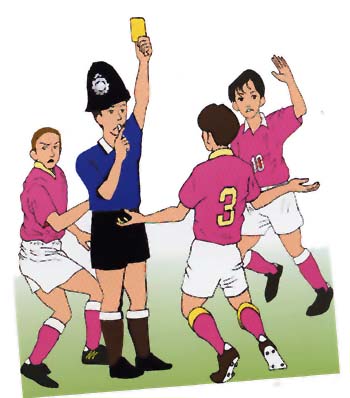
Jon Owen and David Morgan, two Bristol policemen, have organised a six-a-side football league for teenagers in Patchway, one of the poorest parts of the city. Police in several parts of Britain organise similar football leagues or competitions, but usually the aim is just to keep teens occupied, and build confidence between teenagers and the police. Jon and Dave, however, had a better idea.
They have introduced a system in which football results are linked to young people's behaviour off the pitch. Teams score points for winning their matches, but lose points if any team-member does anything he shouldn't.... on the football field or off it! Teams score ten points for winning a match, and five if they draw; but if any player is arrested, the team loses ten points. If a member is caught doing an act of vandalism, such as spraying graffiti, the team loses five points. Three points are lost for more minor offences. The teams also lose points if their members behave badly on the football pitch.
The result has been spectacular; since the football league started, crime and vandalism in the area have fallen by 20%, and none of the teenagers playing in the league has been apprehended by the police.
Instead of encouraging each other to do antisocial things, and cause problems, these teenagers are now encouraging each other to behave properly!
"If any of the lads loses points for the team, 'e won't 'alf get it from the rest!" says Craig, who plays for one of the teams. "We're making sure we all keep out of trouble!"
The idea is already raising interest in other cities. Social workers will also be looking for other ways in which "peer pressure" can be used to produce positive results, rather than negative ones. If more original ways can be found, to make positive use of peer pressure, levels of crime and other social problems among teenagers and young will fall.
Some people also say that a similar system should be introduced for professional footballers. If red cards led to lost points, they might become very rare! Fifty years ago, before red cards were introduced, professional footballers rarely got into fights. In those days, there was enormous peer pressure on them to behave....
In another example of positive peer pressure, statistics show that the number of British teenagers smoking and taking drugs fell steadily from 2000 to 2014. A generation ago drugs and smoking were the coolest things; today the coolest things are phones and social media. Research shows that mobiles have replaced cigarettes, or drugs as a symbol of growing up, in many teenage circles.

WORDS
advertising: publicity - aim: objective - antisocial: that cause problems for other people - behaviour: activities, actions - compel: force - draw: neither win nor lose - keep out of trouble: avoid problems - league: competition - led to: caused - offence: illegal act - peer: a person who is in the same age group, or social group, as others - peer pressure: a force that makes people behave in the same way as their friends - pitch: field for sports - won't 'alf get it: will certainly be in trouble -
Copyright © Linguapress. Do not copy this document to any other website
Copying permitted for personal study, or by teachers for use with their students.
Student worksheet
Sport cuts teenage crime
Interactive cloze exercise. Complete this extract from the article, without consulting the original text.
If you can't remember the original word, try to use any word that makes good sense. Your teacher will tell you if your words are acceptable.
Jon Owen and David Morgan, two Bristol policemen, a six-a-side football league for teenagers in Patchway, one of the parts of the city. Police in several parts of Britain organise similar football leagues or competitions, but usually the is just to keep teens , and build confidence teenagers and the police. Jon and Dave, however, had a better idea.
They have introduced a system in football results are linked to young people's off the pitch. Teams score points for their matches, but lose points if team-member does he shouldn't.... on the football field or off it! Teams score ten points for a match, and five if they draw; but if player is arrested, the team loses ten points; if a member is caught an act of vandalism, such as graffiti, the team loses five points. Three points are lost for more minor offences. The teams also lose points if their members badly on the football pitch.
Other ideas?
EFL teachers: Help develop this resource by contributing extra teaching materials or exercises.
To contribute click here for further details
This teaching resource is © copyright Linguapress .
Republication on other websites or in print is not authorised
 Level
- intermediate.
Level
- intermediate.