
An intermediate level English resource.
The Legendary Mini Cooper
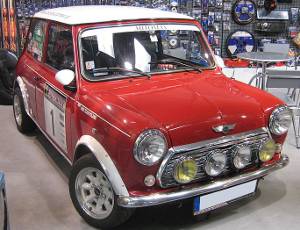
An original Mini Cooper
During the 1960's in particular, the Mini Cooper was the car of the stars. Mini Coopers won the Monte Carlo Rally four times in a row, from 1964 to 1967 (though the 1966 result was contested); they also won races and other rallies throughout the world. Everyone, film stars, pop stars, sports stars, wanted to have a Mini - preferably a Mini Cooper.
The production of Mini Coopers ceased in the 1970's, but people kept wanting them; so the Cooper Car Company - who designed and made Cooper engines for the Mini - sold conversion kits, to change ordinary Minis into Mini Coopers.
In the 1990's - after 17 years - Rover (who then owned the Mini marque) brought back the Mini Cooper , and new Mini Coopers again rolled off the production line. As before, they were all quickly snapped up by keen buyers - proving that the legend was still very much alive!
Nevertheless, when production of the old Mini came to a stop, that meant the end of the line for the original Mini Cooper; but not for long!
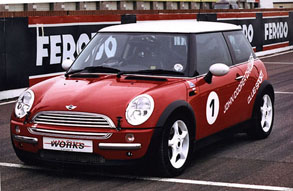 BMW, who had taken over Rover, had
already decided to bring out a new Mini, and with it a new Mini Cooper!
BMW, who had taken over Rover, had
already decided to bring out a new Mini, and with it a new Mini Cooper!
The new Mini Cooper was thus launched on 1st December 2001, and within a few days all the original batch of cars had been sold! All over the world, racing teams were desperate to get hold of one of the new cars, and to be the first to revive a great legend on the race track or in rallies. And the new Mini Cooper has played a big role in some recent films, such as the remake of the "Italian Job". The new ordinary Mini has certainly achieved the same commercial and popular success as its ancestor; there are waiting lists for the new cars in many countries, including the USA! The legend of the Mini is now over fifty years old; and it is still going strong !
Why Cooper?
The Cooper Works is one of several small British companies, which have a high reputation in the world of motor engineering.Other similar companies include MacLaren and Williams (for Formula 1 cars), or Morgan and Lotus for sports cars.
The Cooper Car Company was started by Charles Cooper and his son John, just after the Second World War. Coopers specialised in building high performance cars for racing and motor sport - from Formula 1 to rally cars. They were in fact the biggest of the post-war "privateers", small companies who designed and built racing cars for private individuals. One of their customers was Stirling Moss, the great F1 champion.
Today both John and Charles Cooper are dead; but Michael Cooper, John's son, is still in the company, helping to keep up its long reputation.
..

achieve: obtain - batch: group - cease: stop - customer: client - event: special occasion - for long: for a long time - get hold of - obtain - in a row: in succession, one after the other - keen: avid, very determined - kit: equipment - launch: bring out - marque: name, brand - preferably: and they preferred to have - remain: continue - snap up: buy very quickly -
Return to Linguapress site index
Printing: Optimized for A4 printing from the Firefox browser
Copyright © Linguapress. Do not copy this document to any other website
Copying permitted for personal study, or by teachers for use with their students
Student Worksheet
The Legendary Mini Cooper
Four interactive exercises
- to be done on screen or on paper:
To save your answers, take a screenshot when you have
finished.1. Irregular verbs:
Find the preterite form of the following verbs in the text:win:
keep:
make:
sell:
bring:
mean:
build:
2. Phrasal verbs:
Pay attention to the verbs below, which are used in the article. ....Do you know, or can you guess, the meanings of each of these?Bring back
Snap up
Take over
Bring out
Get hold of
Find out
Keep up.
3. Definite
articles:
In the
following extract from
the article, replace the definite articles where they are needed....
but
do not replace them where they are not possible!!
If no article is needed, write 0
Remember, you NEED
a definite article with a singular count noun (countable item), you do
NOT NEED one with generalisations. You also need an article in cases of
normal apposition.
To save your answers, take a screenshot when you have
finished.
Cooper Works is one of several small British companies, which have a high reputation in world of motor engineering.
Other similar companies include MacLaren and Williams (for Formula 1 cars), or Morgan and Lotus for sports cars.
Cooper Car Company was started by Charles Cooper and his son John, just after Second World War. Coopers specialised in building high performance cars for racing and motor sport - from Formula 1 to rally cars. They were in fact biggest of post-war "privateers", small companies who designed and built racing cars for private individuals. One of their customers was Stirling Moss, great F1 champion.
Today both John and Charles Cooper are dead; but Michael Cooper, John's son, is still in company, helping to keep up its long reputation.
4. Comprehension questions:
Here are some answers: Make up appropriate questions to which they could correspond.
Answer in 1959
b) How
Answer : For over 40 years
c) Which
Answer : The Monte Carlo
d) Why
Answer : Because production of the Mini Cooper ceased.
e) Why
Answer : Because production of all Minis was stopped.
f) When
Answer : On 1st December.
g) Who wereAnswer : Charles and John Cooper.
Ideas for teachers
Simple technical English.
There should be plenty in this text, and the accompanying worksheet, to keep students busy.
One point not exploited in the worksheet is the use of compound nouns in technical English.
The English language is very flexible when it comes to making compound nouns. And it's easy too. Just stick two nouns together, and you have a compound. No need for endings, no need for prepositions. All that is needed is to make sure that the nouns are in the right order! The main noun last.
Look for compounds in this article, and have students try and explain what they mean.
Here are a couple of examples:
the British car industry : the people and companies who manufacture / make cars.
the Monte Carlo rally : a rally that finishes at Monte Carlo.
film stars : actors who are very famous
and so on....
Click here for a guide to using definite articles in English
Other ideas?
EFL teachers: Help develop this resource by contributing extra teaching materials or exercises.
To contribute click here for further details
This teaching resource is © copyright Linguapress - renewed 2020
Originally published in Freeway, the intermediate level English newsmagazine.
Republication on other websites or in print is not authorised
| Linguapress; home | Découvrez l'Angleterre (en français) | Discover Britain |